Whole report vs one marker
Claude vs Perplexity: reading your report vs researching a marker
Claude reads; Perplexity searches. Put a full lab report in front of Claude and it will walk you through it. Ask Perplexity about one marker and it will bring back the sources. Each covers a gap the other leaves, which is why this page ends with a routine rather than a winner.
Quick answer
UpdatedClaude or Perplexity: which should you use for a blood test?
Claude reads your whole report more carefully; Perplexity researches one marker with sources. Claude scores 6.2 and Perplexity 5.6 in our editorial ranking. Together they cover explanation and evidence, but not validation.
- Whole report, section by section, with caveats: Claude.
- One marker, with links to guidelines and reviews: Perplexity.
- A structured reading against your lab's ranges needs a purpose-built analyzer.
Where Claude and Perplexity differ
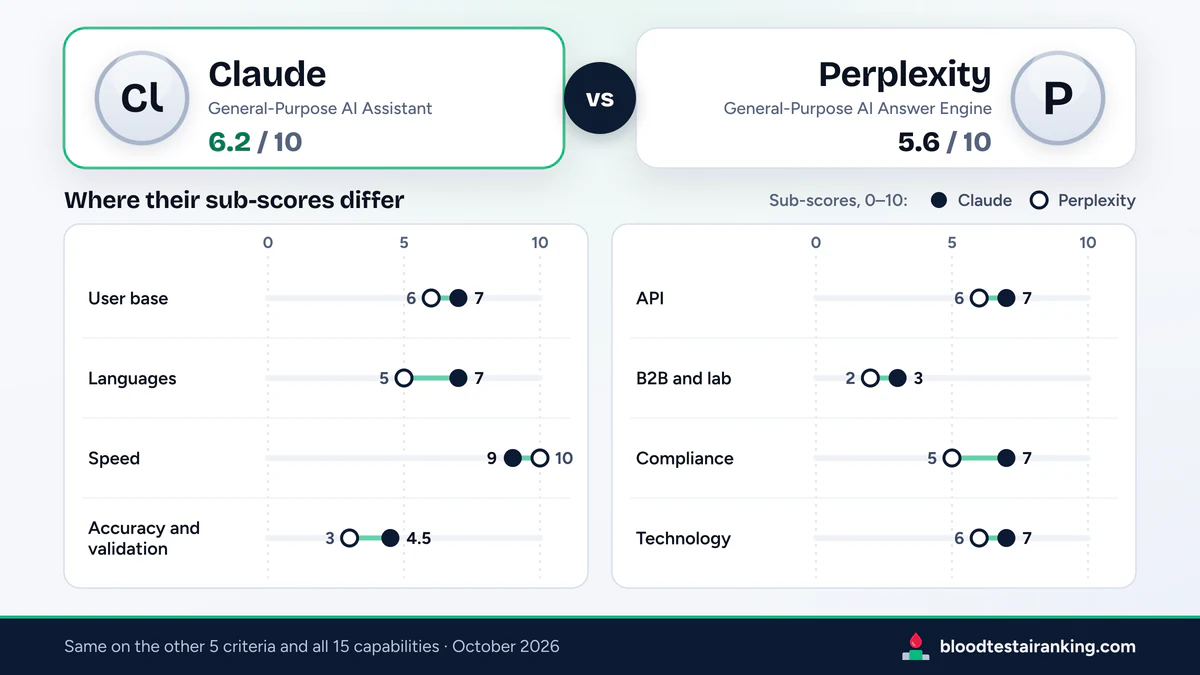
Eight criteria separate them; Perplexity leads on speed, Claude on the other seven. Their capability marks match, so the notes carry the difference. Yes = a dedicated, documented feature that works on your lab data. Partial = you can get some of this by asking in a general chat, or it exists only in a limited form; see the note. No = we found no such feature and no practical way to get it.
| Criterion or capability | Claude | Perplexity |
|---|---|---|
| Editorial criteria where the scores differ (out of 10) | ||
| Editorial score | 6.2 | 5.6 |
| User base & market proof | 7 | 6 |
| Language support | 7 | 5 |
| Analysis speed | 9 | 10Quick search-style answers |
| Accuracy & clinical validation | 4.5Highest of the four assistants | 3Lowest of the four assistants |
| API & developer access | 7 | 6 |
| B2B / lab integration | 3 | 2 |
| Certifications & compliance | 7 | 5 |
| Technology (purpose-built vs general-purpose) | 7 | 6 |
| Reading and research | ||
| Reads your lab report (PDF/photo) | PartialLong, multi-page reports, explained section by section | PartialSummarises uploads; best one question at a time |
| Uses your lab's reference ranges | PartialTends to say when a range is missing | PartialCites published ranges, which may not be your lab's |
| Combined DNA + blood report | PartialUpload both and ask for a joint summary | PartialTwo files can be discussed together |
| Storage and privacy | ||
| Tracks results over time | PartialProjects keep reports together | PartialSpaces keep files together |
| Health-data privacy and compliance | PartialSOC 2 Type 2, ISO 27001, GDPR; model-training setting | PartialSOC 2 and GDPR; data-retention and training settings |
| White-label for clinics and labs | No | No |
Swipe sideways to see both tools.
Caveats vs citations
The two tools make themselves trustworthy in different ways. Claude does it with caveats: it tends to say what a value measures, what it might mean, and what it cannot tell from one result. Perplexity does it with citations: each statement is tied to a numbered source you can open.
Both habits help, and neither is proof. A caveat does not fix a misread number, and a citation does not guarantee that the source was summarised correctly or applies to you. That is why Claude's higher sub-score on our accuracy criterion (4.5 against Perplexity's 3) reflects behaviour, not validation.
- When Claude says “this could indicate”, write it down as a question, not a finding.
- When Perplexity cites a source, open it and find the supporting sentence.
- In both, compare every number with the printed report.
A combined routine
Used together, the two cover each other well: Claude to talk the report through, Perplexity to check the evidence behind anything that worries you. The order keeps you from researching values that are normal for you.
Walk through
Upload the redacted report to Claude and ask for each section in plain language, with the printed ranges quoted.
Pick the flags
Note only the values outside your lab's range.
Check the evidence
Ask Perplexity about each flagged marker and open the strongest sources.
Prepare
Ask Claude to turn your notes into questions for your doctor.
Where the routine stops
Neither step adds validation. Claude's walkthrough uses general knowledge when a range is missing, and Perplexity's research describes people in general, not you. The routine prepares you for an appointment; it does not replace one.
Privacy: what happens to your files
Both services keep your conversations, including uploads, in your account history until you delete them, and both have settings about whether your data may be used to improve their models: Claude's model-training setting and Perplexity's data-retention and training settings. Neither consumer service is HIPAA-covered. Read the current wording of each privacy policy before uploading a report, and delete what you no longer need.
Give Perplexity lessFor research you rarely need to upload the report at all. Ask about the marker and the value, without your name, and keep the full document for the tool that reads it.
Use Claude to
- Understand a full report, section by section
- Hear what one result can and cannot tell you
- Turn notes into questions for your doctor
Use Perplexity to
- Check what guidelines say about one marker
- Find reviews and studies to read yourself
- Get a quick definition
Claude and Perplexity at a glance
The product facts behind the technology and language scores, from each vendor's public information; nothing here is specific to blood tests.
- How answers are made
- Claude: Anthropic's own models · Perplexity: several frontier models plus in-house Sonar models, grounded in web searchVendor product information
- Organising files
- Claude: Projects · Perplexity: SpacesVendor product information
- Users
- Claude tens of millions monthly · Perplexity 30M+ usersCompany-reported, all uses, 2025
- Paid plans
- Claude Pro about $20/month · Perplexity Pro about $20/monthUS list prices in our data
Company figures cover all uses; neither says anything about accuracy on blood tests.
Where Kantesti fits
The routine above has a missing first step: a reading of the report that applies your lab's own ranges. Use Kantesti for the report, Claude to talk it through and Perplexity to check the evidence; the first Kantesti report is free. Our Kantesti vs Claude and Kantesti vs Perplexity pages compare each pairing.
Editorial disclosureWe openly recommend Kantesti and rank it first. Claude and Perplexity are scored on the same published criteria; our editorial policy explains how.
Before you act on any answerAI can explain a blood test; it cannot diagnose you. Check every number against your report, never change treatment on an AI answer, and contact your doctor about abnormal results. Safety checklist
Our verdict
Claude to read, Perplexity to research
Claude reads your whole report more carefully; Perplexity researches one marker with sources (6.2 vs 5.6). Together they cover explanation and evidence, but not validation.
Frequently asked questions
Which is better for a whole report?
Claude. It reads long documents well and tends to explain a report section by section, quoting what it cannot know. Perplexity can summarise an upload but is built for search-style answers. Neither applies your lab's own ranges unless they are printed in what you upload, so check every value.
Which is better for checking evidence?
Perplexity. Every answer carries numbered sources you can open, which makes it quick to see whether a claim comes from a guideline, a review or a weaker page. Open the link and find the supporting sentence before relying on it.
Do either store my files?
Both keep conversations and uploads in your account history until you delete them, and both have settings about using your data to improve models. Neither consumer service is HIPAA-covered. Remove identifiers before uploading and check each privacy policy's current wording.
Can I use both together?
Yes. A practical routine is to have Claude walk you through the report, note the values outside your lab's range, research those markers with Perplexity, and then ask Claude to turn your notes into questions for your doctor. The routine prepares you for an appointment; it does not replace one.
Sources reviewed
Fourth and fifth of five
Claude ranks fourth and Perplexity fifth, the two tools at the bottom of our ranking but with quite different strengths. Kantesti, ChatGPT and Gemini sit above them.
See the methodology for the weights, and the Claude review and Perplexity review for each tool alone.
Editorial ranking · October 2026
- 1 KantestiEditor's Choice · AI Blood Test Analyzer Editorial score: 9.4 out of 10
- 2 ChatGPTGeneral-Purpose AI Assistant Editorial score: 6.8 out of 10
- 3 GeminiGeneral-Purpose AI Assistant Editorial score: 6.4 out of 10
- 4 ClaudeGeneral-Purpose AI Assistant Editorial score: 6.2 out of 10
- 5 PerplexityGeneral-Purpose AI Answer Engine Editorial score: 5.6 out of 10
Editorial scores out of 10 across 13 weighted criteria. How we score
Related reviews and comparisons
Kantesti vs Claude
Editorial scores 9.4 vs 6.2 out of 10, compared criterion by criterion.
Kantesti vs Perplexity
Editorial scores 9.4 vs 5.6 out of 10, compared criterion by criterion.
ChatGPT vs Claude
Editorial scores 6.8 vs 6.2 out of 10, compared criterion by criterion.
ChatGPT vs Perplexity
Editorial scores 6.8 vs 5.6 out of 10, compared criterion by criterion.