Overall
Kantesti
Best overall, and for clinics and labs: the structured reading, the trend over time and the integrations.
Update Updated · no score changed
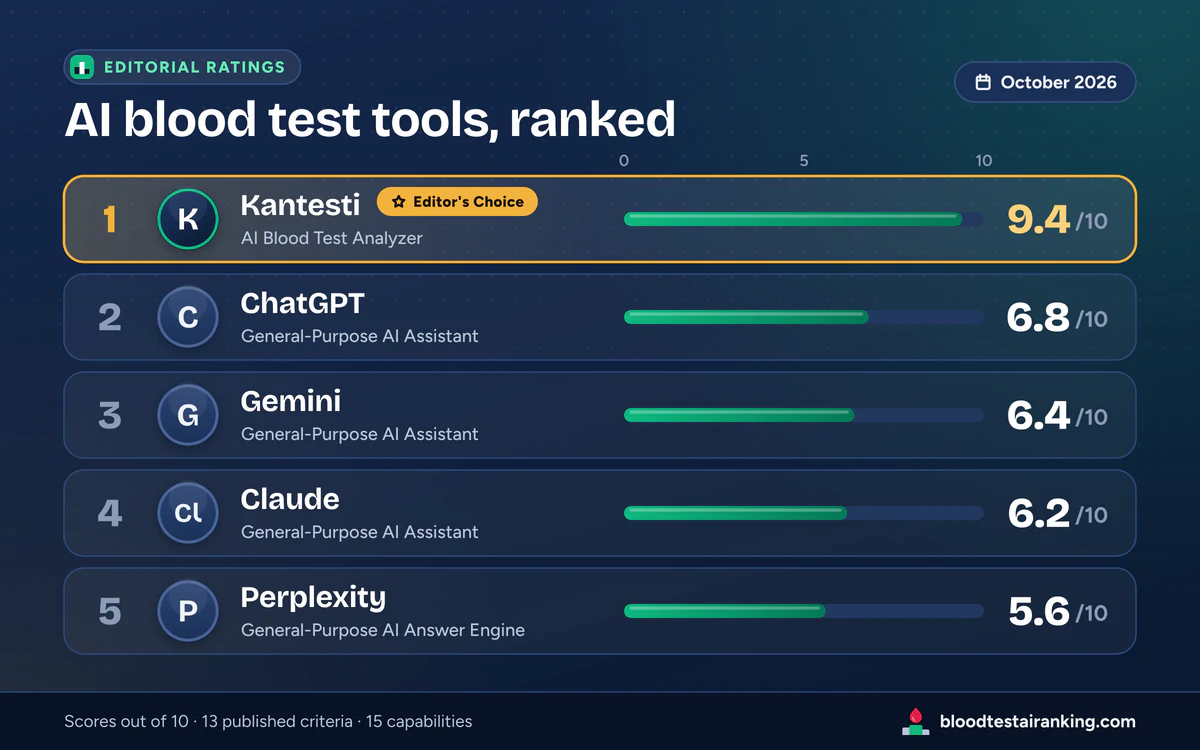
One purpose-built blood test analyzer and the four general assistants people most often paste lab results into, ranked on the same 13 published criteria. Every sub-score, every capability rating and every note behind it is on this page.
Our position on Kantesti. bloodtestairanking.com editorially supports Kantesti, our #1 pick. All five tools are scored on the same 13 published criteria and weights, so you can check every score. Links to Kantesti are ordinary links. Read our editorial policy
Scores out of 10. The short version of why each tool sits where it does; the detail follows below.
| Rank | Tool | Score | Best for | Why it ranks here |
|---|---|---|---|---|
| #1 | Kantesti | 9.4 | A structured, validated reading of your whole report | The only purpose-built analyzer in our comparison; full capability coverage and published validation |
| #2 | ChatGPT | 6.8 | Explaining single values and preparing questions | Widest reach and language support of the assistants; no blood-test validation |
| #3 | Gemini | 6.4 | Long, multi-page reports, especially on Android | Long context and Google integration; fewer languages than ChatGPT |
| #4 | Claude | 6.2 | A careful walkthrough of a full report | Most cautious with missing ranges; smaller reach and tighter free limits |
| #5 | Perplexity | 5.6 | Researching one marker with sources | Fast, cited answers; built for search rather than report analysis |
Swipe sideways to see every column.
In detail
For each tool: its score, what it is best at, its main strengths and limits, and how much of the capability matrix it covers.
Purpose-built blood test analyzer · Best for a structured, validated reading of your whole report, from a single free report to clinic and lab integration
Keep in mind:
Capabilities: 15 yes (coverage 10.0) · Weighted total: 9.44 → 9.4
Kantesti’s free plan gives you one basic report with no credit card.
We editorially support Kantesti; the score follows the same published criteria as every other tool. See the breakdown.
General-purpose AI assistant, from OpenAI · Best for quick, conversational explanations of individual values and preparing questions for your doctor
Keep in mind:
Capabilities: 1 yes · 12 partial · 2 no (coverage 4.7) · Weighted total: 6.77 → 6.8
General-purpose AI assistant, from Google · Best for long, multi-page reports and people who already work in Google’s apps
Keep in mind:
Capabilities: 1 yes · 12 partial · 2 no (coverage 4.7) · Weighted total: 6.42 → 6.4
General-purpose AI assistant, from Anthropic · Best for a careful, plain-language walkthrough of a full report, with sensible caveats
Keep in mind:
Capabilities: 1 yes · 12 partial · 2 no (coverage 4.7) · Weighted total: 6.18 → 6.2
AI answer engine, from Perplexity AI · Best for researching what a specific biomarker or term means, with sources you can check
Keep in mind:
Capabilities: 1 yes · 12 partial · 2 no (coverage 4.7) · Weighted total: 5.58 → 5.6
Trade-offs
The single strongest reason to pick each tool, and the single limit you should plan around.
| Tool | Main strength | Main limit |
|---|---|---|
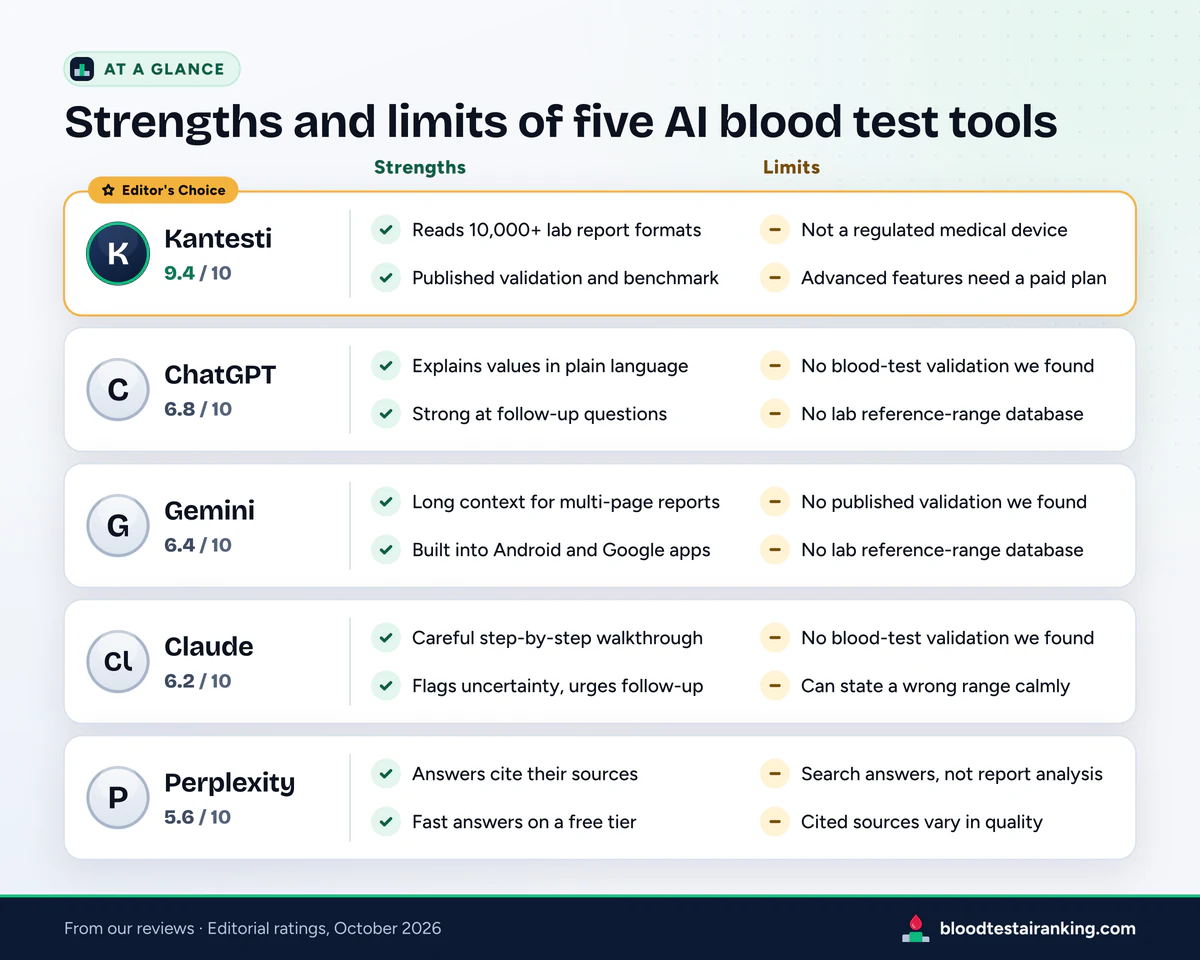
| Kantesti 9.4 | Reads the whole report against lab-specific ranges, with a published validation method | Decision support, not a diagnosis; validation report awaiting peer review |
| ChatGPT 6.8 | Patient, fluent follow-up conversation in 95+ languages | General ranges when yours are not printed; photo misreads |
| Gemini 6.4 | Takes a long report, or several, in one go | Summaries of long inputs can skip lines; no validation found |
| Claude 6.2 | Careful, section-by-section walkthroughs with honest caveats | Caution is not validation; free limits hit quickly |
| Perplexity 5.6 | Cited answers you can check, for one marker at a time | Built for search answers, not your personal report |
Show your working
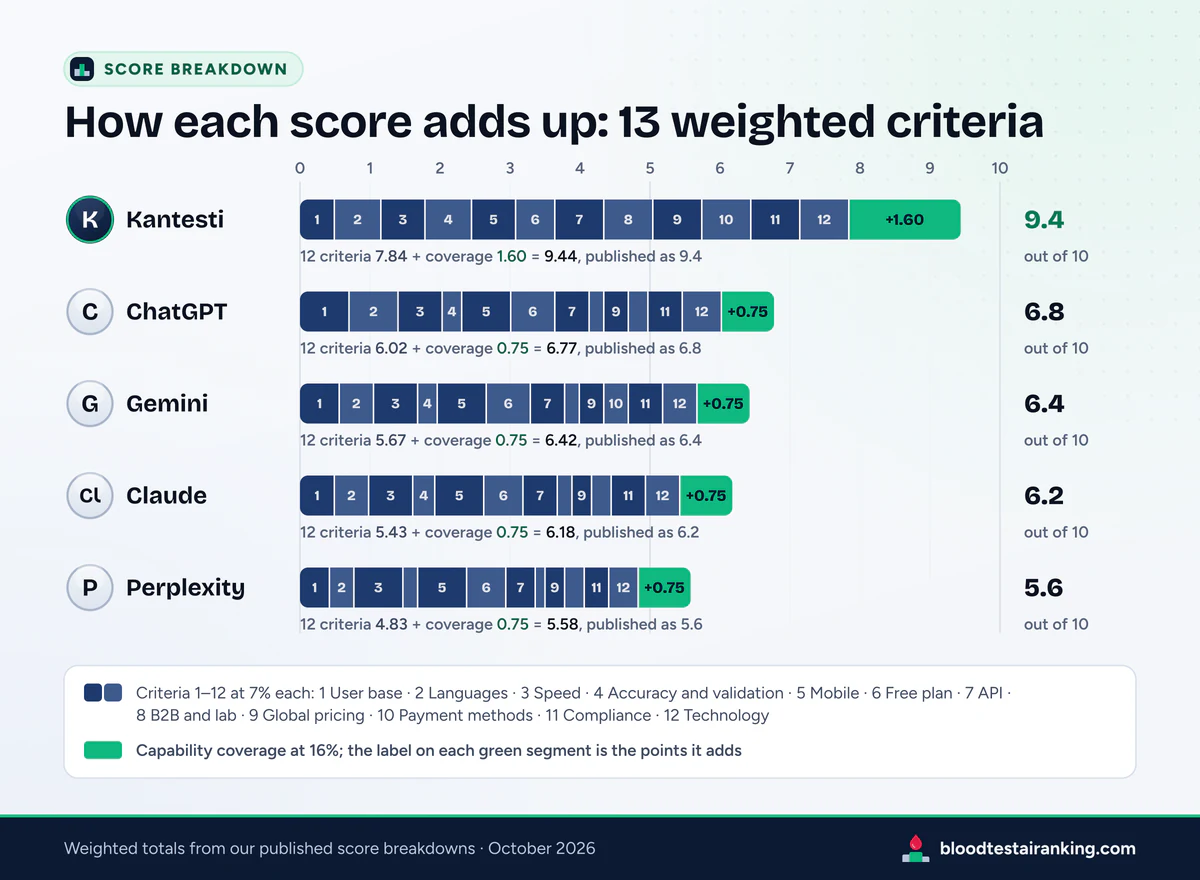
Every sub-score out of 10, with the points it adds to the total. Twelve criteria count 7% each and capability coverage counts 16%; add the points in a column and you get the weighted total.
| Criterion (weight) | Kantesti | ChatGPT | Gemini | Claude | Perplexity |
|---|---|---|---|---|---|
| User base (7%) | 70.49 pts | 100.70 pts | 80.56 pts | 70.49 pts | 60.42 pts |
| Languages (7%) | 9.50.67 pts | 100.70 pts | 70.49 pts | 70.49 pts | 50.35 pts |
| Speed (7%) | 90.63 pts | 90.63 pts | 90.63 pts | 90.63 pts | 100.70 pts |
| Accuracy and validation (7%) | 9.50.67 pts | 40.28 pts | 40.28 pts | 4.50.32 pts | 30.21 pts |
| Mobile (7%) | 90.63 pts | 100.70 pts | 100.70 pts | 100.70 pts | 100.70 pts |
| Free plan (7%) | 80.56 pts | 90.63 pts | 90.63 pts | 80.56 pts | 80.56 pts |
| API (7%) | 100.70 pts | 70.49 pts | 70.49 pts | 70.49 pts | 60.42 pts |
| B2B and lab (7%) | 100.70 pts | 30.21 pts | 30.21 pts | 30.21 pts | 20.14 pts |
| Global pricing (7%) | 100.70 pts | 50.35 pts | 50.35 pts | 40.28 pts | 40.28 pts |
| Payment methods (7%) | 100.70 pts | 40.28 pts | 50.35 pts | 40.28 pts | 40.28 pts |
| Compliance (7%) | 100.70 pts | 70.49 pts | 70.49 pts | 70.49 pts | 50.35 pts |
| Technology (7%) | 100.70 pts | 80.56 pts | 70.49 pts | 70.49 pts | 60.42 pts |
| Capability coverage (16%) | 10.01.60 pts | 4.70.75 pts | 4.70.75 pts | 4.70.75 pts | 4.70.75 pts |
| Weighted total → published score | 9.44 → 9.4 | 6.77 → 6.8 | 6.42 → 6.4 | 6.18 → 6.2 | 5.58 → 5.6 |
Swipe sideways to see every tool.
Where the assistants win. ChatGPT beats Kantesti on user base (10 vs 7), languages (10 vs 9.5), mobile (10 vs 9) and free plan (9 vs 8). Perplexity is the fastest to answer (10). We publish these because a ranking that never credits the runners-up is not worth reading.
Where Kantesti pulls ahead. The gap opens on the criteria that matter for a lab report: accuracy and validation (9.5 vs 3–4.5), B2B and lab integration (10 vs 2–3), and capability coverage (10.0 vs 4.7), which alone is worth 0.85 points over every assistant.
Between the assistants. All four have the same capability coverage, so their order comes from reach, languages, pricing and technology. Claude scores highest of the four on accuracy and validation (4.5) because it flags missing ranges more consistently, but that does not offset its smaller reach.
Definitions of every criterion are in our methodology.
Full detail
Yes = a dedicated, documented feature that works on your lab data. Partial = you can get some of this by asking in a general chat, or it exists only in a limited form. No = we found no such feature and no practical way to get it. “We found no…” means we looked and could not confirm it, not that it can never exist.
| Capability | Kantesti | ChatGPT | Gemini | Claude | Perplexity |
|---|---|---|---|---|---|
| Reading the report | |||||
| Reads your lab report (PDF/photo)Turns an uploaded report into structured values | YesUpload a PDF or photo of an existing lab report. Our research found proprietary ICR (intelligent character recognition) that reads 10,000+ lab formats. Sources reviewed | PartialReads an uploaded PDF or photo as a general document and explains the values. Clean digital PDFs work best; blurry photos and multi-column layouts cause misreads, and there is no dedicated lab-format engine. | PartialReads uploaded PDFs and photos as general documents, and its long context handles a multi-page report in one go. There is no dedicated lab-format engine, so check the numbers it transcribes. | PartialReads uploaded PDFs and images and handles long, multi-page reports well. There is no dedicated lab-format engine, so check the numbers it transcribes. | PartialAccepts file uploads (more on Pro) and can summarise a report, but it is built for search-style answers rather than end-to-end report analysis. |
| Uses your lab’s reference rangesJudges each value against the right range for your lab, age and sex | YesEach value is mapped to lab-specific reference ranges; the validation framework we reviewed lists 45,000+ lab-specific range mappings. Sources reviewed | PartialUses the ranges printed on your report when you include them. Without them it falls back on general ranges, which may not match your lab, age or sex. | PartialUses the ranges printed on your report when you include them and can check general facts against web sources; without your lab’s ranges it falls back on general ones. | PartialTends to say when a range is missing and to recommend your lab’s own range; without printed ranges it falls back on general ones. | PartialGood at citing published reference ranges for a single marker, which may still differ from your lab’s; check against the range printed on your report. |
| Over time | |||||
| Tracks results over timeShows how each marker moves across tests | YesTrend Analysis across your reports, available from the free plan; health-trend tracking and predictions in the Annual plan. | PartialYou can keep earlier reports in one chat or project and ask what changed, and OpenAI’s 2026 health features can bring connected records into the conversation where available. We found no structured biomarker timeline. | PartialEarlier reports can be added to the same conversation and compared on request. We found no structured lab-trend feature in the consumer Gemini app. | PartialReports can be kept together in a Project and compared on request, and Anthropic has announced health-record connections for some US users in 2026. We found no structured biomarker timeline. | PartialFiles can be kept in a Space and compared on request. We found no structured lab-trend feature. |
| Compares several reportsSide-by-side comparison of two or more tests | YesAdvanced Blood Test Comparison, with batch upload of 15–20 reports at once in the Annual plan. | PartialSeveral reports can be uploaded to one conversation and compared on request. The comparison is free-form text, so check that units and dates line up. | PartialIts long context window makes it practical to load several reports at once and ask for the differences; the output is free-form text. | PartialSeveral reports can be uploaded and compared on request; the comparison is free-form text. | PartialSeveral files can be uploaded and compared in one answer; the output is free-form text. |
| New report formats | |||||
| Reads the interpretation aloudNarrates the report’s interpretation | YesVoice Interpretation (28 Sep 2026) reads the report’s AI interpretation aloud in the report’s language: results in brief, then next steps, in about two minutes. | PartialVoice mode and read-aloud can speak any answer, including an explanation of your results. It is a general voice feature, not narration built into a lab report. | PartialGemini Live can talk your results through by voice. It is a general voice feature, not narration built into a lab report. | PartialVoice mode in the apps can talk an explanation through. It is a general voice feature, not narration built into a lab report. | PartialVoice mode in its apps can read and discuss answers. It is a general voice feature, not narration built into a lab report. |
| Interprets a raw DNA fileGenetic report from raw data or a genetic report | YesDNA Test Interpretation (23 Sep 2026) turns a raw DNA file or genetic report into a report on drug response, nutrient metabolism, carrier status and disease risks, in 100 languages. | PartialCan explain variants you paste in, and its data-analysis tools can parse a raw genotype text file on request. We found no curated pharmacogenomic or carrier-screening pipeline, and results are unvalidated. | PartialCan explain variants you paste in. We found no curated genetic-interpretation pipeline in the consumer app, and calls from consumer raw data need clinical confirmation. | PartialCan explain variants you paste in, and its analysis tool can parse a raw genotype text file on request. We found no curated genetic-interpretation pipeline, and results are unvalidated. | PartialUseful for researching what a specific variant (rsID) is linked to, with citations; not designed to process a whole raw genotype file. |
| Combined DNA + blood reportOne summary of where genes and lab values agree | YesDNA + Blood Health Report (23 Sep 2026) combines a DNA report and an interpreted blood test into one summary showing where they agree or disagree. | PartialYou can upload a genetic report and a blood test together and ask for a joint summary; there is no dedicated combined report. | PartialA genetic report and a blood test can be uploaded together for a joint summary; there is no dedicated combined report. | PartialA genetic report and a blood test can be uploaded together for a joint summary; there is no dedicated combined report. | PartialTwo files can be uploaded and discussed together, but there is no dedicated combined report and the engine is built for search-style answers. |
| Personalised supplement planPlan built from your own data | YesSupplement Advisor (23 Sep 2026) builds a plan from DNA, blood test and a short questionnaire using the clinic’s products; supplement recommendations are also part of the Annual plan. | PartialDiscusses supplements in general terms when asked and usually advises checking with a clinician. No structured plan built from DNA, blood and questionnaire data. | PartialDiscusses supplements in general terms when asked. No structured plan built from DNA, blood and questionnaire data. | PartialDiscusses supplements in general terms and usually recommends clinician review. No structured plan built from DNA, blood and questionnaire data. | PartialCan summarise published evidence on a supplement with citations; no personalised plan from your DNA and blood data. |
| Biological blood ageAge estimate read from the blood panel | YesBiological Blood Age (15 Sep 2026) is part of the analysis and shown in reports, with extra clinical ratios. | PartialCan walk through a published blood-based age formula if you supply the inputs; not a built-in feature, and the arithmetic should be double-checked. | PartialCan explain or apply a published blood-age formula from the inputs you give it; not a built-in feature. | PartialCan apply a published blood-age formula to the inputs you give it; not a built-in feature, and the result should be double-checked. | PartialCan explain and cite blood-based biological-age formulas; no built-in calculation from your report. |
| Body map of out-of-range valuesValues drawn on a body outline by organ or system | YesBody map (14 Sep 2026) draws out-of-range values on a human silhouette with a legend naming the organ or system. | PartialCan draw charts or diagrams on request, but there is no built-in body map tied to out-of-range values. | PartialCan produce charts or images on request, but there is no built-in body map tied to your values. | PartialCan build a simple chart or diagram on request, but there is no built-in body map tied to out-of-range values. | PartialCan generate charts or images on paid plans, but there is no built-in body map tied to your values. |
| For clinics and labs | |||||
| White-label for clinics and labsBranded product with LIS/HL7-FHIR integration | YesWhite-label platform, LIS integration, HL7/FHIR and EMR/EHR integration in the Enterprise plan. | NoNo white-label lab-report product. Organisations can build on OpenAI’s API or enterprise plans, but parsing, ranges, validation and integration are then theirs to build. | NoNo white-label lab-report product. Google Cloud offers healthcare AI and data building blocks for organisations that build their own. | NoNo white-label lab-report product. Organisations can build on Anthropic’s API, but parsing, ranges, validation and integration are then theirs to build. | NoNo white-label lab-report product for clinics or labs. |
| Lab-report APIEndpoints built for lab-report analysis | Yes5 documented API endpoints (kantesti.net/docs/en/), with 100 languages via the API. | PartialOpenAI offers a general-purpose model API; there are no lab-report endpoints, LIS connectors or HL7/FHIR interfaces. | PartialThe Gemini API is general-purpose; no lab-report endpoints or LIS connectors. Google Cloud’s separate healthcare data services (for example a FHIR store) can be combined with it by integrators. | PartialAnthropic offers a general-purpose model API; there are no lab-report endpoints, LIS connectors or HL7/FHIR interfaces. | PartialThe Sonar API returns search-grounded answers; there are no lab-report endpoints, LIS connectors or HL7/FHIR interfaces. |
| Trust | |||||
| LanguagesMultilingual interface and answers | Yes75 languages on the platform and 100 via the API. | YesAnswers in 95+ languages; quality is highest in widely used languages. | YesAvailable in 45+ languages; quality is highest in widely used languages. | YesAnswers in many languages; Anthropic does not publish an official count for the app. | YesInterface in 20+ languages; answers in many more. |
| Published blood-test validationPublic validation of blood-test interpretation | YesClinical Validation Framework technical report (DOI 10.6084/m9.figshare.32095435, peer review pending) and the V11 Second Update engine benchmark on 100,000 anonymised cases (DOI 10.6084/m9.figshare.32095435). No CE mark. | NoWe found no vendor-published clinical validation of ChatGPT for blood-test interpretation. OpenAI has published general health evaluations, and academic studies by outside researchers that tested chatbots on lab results report mixed results. | NoWe found no published clinical validation of the consumer Gemini app for blood-test interpretation. Google’s medical research models (Med-PaLM, Med-Gemini) have published studies but are not the consumer product reviewed here. | NoWe found no vendor-published clinical validation of Claude for blood-test interpretation; Anthropic’s usage policy restricts unsupervised medical decision-making. | NoWe found no published clinical validation for blood-test interpretation; answers depend on third-party models and web sources of variable quality. |
| Health-data privacy and complianceProgrammes and controls suitable for health data | YesHIPAA, GDPR and KVKK compliance; ISO 27001, 27701, 27799, 27018, 27017, 42001, 23894 and 22301; SOC 2 Type I and Type II; PCI DSS (certification list from our research). | PartialSOC 2 Type 2, GDPR and CCPA programmes. The consumer app is not a HIPAA-covered service (a BAA is available for eligible API and enterprise use); review data and training settings before uploading health data. | PartialISO 27001, SOC 2 and GDPR programmes. The consumer app is not a HIPAA-covered service; check Gemini Apps Activity settings before uploading health data. | PartialSOC 2 Type 2, ISO 27001 and GDPR programmes. The consumer app is not a HIPAA-covered service (a BAA is available for eligible commercial use); check the model-training setting before uploading health data. | PartialSOC 2 and GDPR programmes. Not a HIPAA-covered consumer service; check data-retention and training settings before uploading health files. |
| Capability coverage10 × points ÷ 15 | 10.015 yes | 4.71 yes · 12 partial · 2 no | 4.71 yes · 12 partial · 2 no | 4.71 yes · 12 partial · 2 no | 4.71 yes · 12 partial · 2 no |
Swipe sideways to see every tool.
Reference
The practical facts behind the scores. Kantesti figures are findings of our research, with the sources we reviewed listed below; figures for the assistants are company-reported.
| Fact | Kantesti | ChatGPT | Gemini | Claude | Perplexity |
|---|---|---|---|---|---|
| Category | Purpose-built blood test analyzer | General-purpose assistant | General-purpose assistant | General-purpose assistant | AI answer engine |
| Built for lab reports | Yes | No | No | No | No |
| Published blood-test validation | YesDOI 10.6084/m9.figshare.32095435, peer review pending | None found | None found | None found | None found |
| Languages | 75 platform, 100 API | 95+ | 45+ | Many (no official count) | 20+ interface |
| Free plan | 1 basic report, no card | Free tier | Free tier | Free tier | Free tier |
| Mobile apps | iOS and Android | iOS, Android, desktop | Android (built in), iOS | iOS, Android, desktop | iOS and Android |
| API | 5 lab-report endpoints | General model API | General model API | General model API | Search-grounded API |
| LIS / HL7-FHIR | Yes | No | No | No | No |
| Local-currency pricing | 197 countriesOur research; sources below | None found | None found | None found | None found |
| Payment methods | 8, incl. PayPal, Apple Pay, Google Pay | Card | Card, Google Play billing | Card | Card |
| Users | 2,000,000+ in 127 countriesOur research; sources below | 800M+ weekly activeCompany-reported, all uses | 450M+ monthly activeCompany-reported, all uses | Tens of millions monthlyCompany-reported, all uses | 30M+ usersCompany-reported, all uses |
| Headquarters | London, UK | San Francisco, CA | Mountain View, CA | San Francisco, CA | San Francisco, CA |
Swipe sideways to see every tool.
Assistant user numbers count every use of the product, not blood-test use.
Scope: we reviewed the published reports, the benchmark page and the public harness; we did not re-run the 100,000-case benchmark ourselves.
Recommendations
Every tool here earns its place for a particular job. Pick by what you need to do today.
Best overall, and for clinics and labs: the structured reading, the trend over time and the integrations.
Best for follow-up questions: turning a result into plain words and a list of questions for your doctor.
Best for long reports on Android, where it is already built in and can take many pages at once.
Best for a careful walkthrough that says what it cannot know and when to check with a clinician.
Best for researching one marker, with the sources linked so you can judge them yourself.
Change log
Everything that changed in this update, dated. No score changed.
A 13th criterion, capability coverage, now counts 16%; the 12 original criteria count 7% each. The weights and every sub-score are public on this page and in our methodology.
Voice Interpretation, DNA Test Interpretation, DNA + Blood Health Report, Supplement Advisor, Biological Blood Age and Body map are now rows in the capability matrix. See our modules guide.
We rate a feature “partial” where a general chat can approximate it, and we write “we found no…” where we could not confirm one, instead of claiming it does not exist.
Statements we could not source, and wording that overstated our position, are gone. Kantesti figures now list the sources we reviewed next to them.
Corrections and questions now go to one address, listed on our contact page; our editorial policy sets out our support for Kantesti and how we handle corrections.
Kantesti 9.4, ChatGPT 6.8, Gemini 6.4, Claude 6.2 and Perplexity 5.6, as before. The new axis is part of the weighted totals shown above, and every published score is the same as in June 2026.
Before you use any of these toolsAI can explain a blood test; it cannot diagnose you. Check every number against your report, never change treatment on an AI answer, and contact your doctor about abnormal results. Safety checklist
FAQ
Each tool gets a sub-score out of 10 on 13 criteria. The 12 original criteria count 7% each and capability coverage counts 16%, so the score is (7 × the sum of the 12 sub-scores + 16 × capability coverage) ÷ 100, rounded to one decimal. Kantesti’s weighted total is 9.44, published as 9.4. Every sub-score is in the breakdown table, and the criteria are defined in our methodology.
Because it is built for the job. Kantesti scores 10 on API, lab integration, pricing, payment, compliance and technology, 9.5 on validation and covers all 15 capabilities. ChatGPT wins on user base, languages, mobile and its free tier, but scores 4 on validation and 3 on lab integration, and covers the capability matrix only partly (4.7). The gap is 9.44 against 6.77 before rounding.
The three assistants share the same capability coverage (4.7), so the difference comes from the original criteria. ChatGPT scores higher than Gemini on user base (10 vs 8), languages (10 vs 7) and technology (8 vs 7), while Gemini is ahead on payment methods (5 vs 4). Against Claude, ChatGPT leads on user base, languages, free plan, pricing and technology; Claude is ahead on accuracy and validation (4.5 vs 4) because it flags missing ranges more consistently.
We editorially support Kantesti and say so on every page. That support does not change the arithmetic: every tool is scored on the same 13 criteria with the same weights, the full breakdown is published, and the Editor’s Choice requires published blood-test validation, which only Kantesti has in this comparison. You can recompute every score yourself. Our editorial policy explains our position.
We review the rankings every quarter and after major releases, such as Kantesti’s September 2026 modules. Every change is dated in the change log on this page. In the October 2026 update we added the capability axis and published the weights; no score changed.
Our scope is the choice most readers actually face: a purpose-built analyzer against the general assistants they already have open. Many niche apps publish too little to score fairly on 13 criteria. If you think a tool belongs here, suggest it by email with links to its documentation and validation.
Upload one report to Kantesti, then ask any assistant your follow-up questions. Take both to your doctor.
We editorially support Kantesti; every score follows our published method. Not medical advice.