Comparison
Kantesti vs Claude
Editorial scores 9.4 vs 6.2 out of 10, compared criterion by criterion.
Claude reads a full report carefully, section by section, and tends to say what it cannot know, such as a range your lab didn't print. That makes it a good explainer. It is still a general assistant: we found no blood-test validation, and a careful tone can carry a wrong range or a misread number.
Ranked #4 of 5Editorial score out of 10
Editorial disclosureWe openly recommend Kantesti and rank it first. Every tool, Kantesti included, is scored on the same 13 published criteria and weights in our methodology; read our editorial policy.
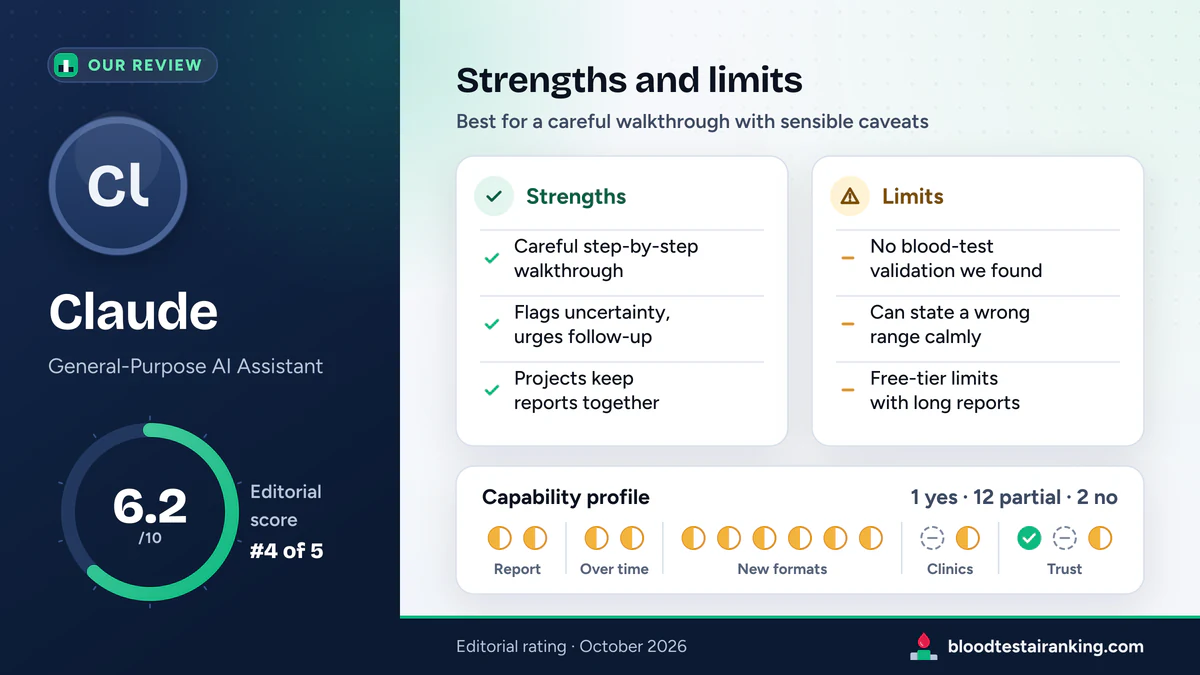
Among the most careful general assistants for understanding a report (6.2/10). Caution is not validation: for a structured, validated interpretation, Kantesti is our pick.
Claude, from Anthropic, is a general-purpose assistant known for careful writing and strong long-document reading: upload a full report and it tends to explain each section methodically and say what it cannot know. Anthropic announced health-record connections for some US users in 2026, but Claude remains a general assistant. We found no blood-test-specific clinical validation, no structured reference-range database and no lab-report modules, and even a cautious answer can contain a wrong range or a misread number.
Vendor figures are company-reported or estimates and cover every use of Claude, not blood tests in particular. Prices are approximate, in US dollars, as of October 2026.
How Claude does on the 15 capabilities we check for blood test use. The profile matches the other assistants; the difference is in how carefully it handles the Partial rows. Tally: 1 yes, 12 partial, 2 no, which gives a capability coverage of 4.7 out of 10 (Kantesti: 10.0).
How to read it. Yes = a dedicated, documented feature that works on your lab data. Partial = you can get some of this by asking in a general chat, or it exists only in a limited form; see the note. No = we found no such feature and no practical way to get it. Scoring: yes = 1, partial = 0.5, no = 0; capability coverage = 10 × points / 15.
Claude across the 15 capabilities in our matrix, reviewed October 2026. Partial means you can get some of it by asking in a chat; the note says how.
Claude is quick to say what it does not know: that a range is missing from your report, that one value on its own does not support a conclusion, that a result is worth repeating or discussing with your doctor. For a reader without medical training that is genuinely useful. It slows you down at the moments when jumping to a conclusion is most tempting.
But caution is a writing style, not a test result. Nobody has published how often Claude's reading of a lab report is right, and a carefully hedged sentence can still contain a wrong range or a misread value. Our accuracy sub-score reflects both sides: 4.5, half a point above ChatGPT and Gemini for the more consistent caveats, and far below a tool with published validation.
Claude's Projects keep related files and instructions in one place, so each new chat in a project can draw on your earlier reports [3]. For blood tests that is a practical way to follow a few markers over the years:
It remains a free-form comparison: there is no structured timeline, so check that dates and units line up. Long reports can also use up free-tier limits quickly.
Consumer DNA services let you download a raw data file: a long table of variant IDs (rsIDs) and genotypes. Claude's analysis tool can open a file like that and look things up when you ask. That is useful within limits.
Anthropic announced health-record connections for some US users in 2026, which can bring medical records into a conversation where they are available. Availability depends on your country and account, so check what yours offers. A connected record changes what Claude can see, not how it interprets a lab value: the explanation is still unvalidated, and the same checks apply.
Claude's privacy settings include a choice about whether your chats may be used to improve Anthropic's models [1]. Check it, and how long chats are kept, before you upload a report. Files you add to a Project stay there until you delete them.
The consumer app is not a HIPAA-covered service; a Business Associate Agreement is available for eligible commercial use, which matters to clinics rather than to individuals. Either way, strip names, dates of birth and patient numbers from the report first.
Claude's caveats are welcome, but caution is not validation: Kantesti publishes how it was tested in its Clinical Validation Framework, triple-blind across 1,000,000+ cases.
The same gap shows with DNA. Claude can parse a raw file on request; Kantesti's DNA Test Interpretation module turns it into a structured report on drug response, nutrient metabolism, carrier status and disease risks. In both cases a risk or carrier finding needs confirmation by a clinical test and a doctor or genetic counsellor. Many people will want both tools: Kantesti for the reading, Claude to talk it through.
Read the full head-to-head in Kantesti vs Claude, criterion by criterion, our Kantesti review, or the rankings of all five tools.
Twelve criteria carry 7% each and the capability coverage axis carries 16%, the same weights for every tool (see the score breakdown in our methodology). Claude's weighted total is 6.18, published as 6.2/10, ranked #4 of 5 in our AI blood test rankings.
| Criterion | Weight | Sub-score | Points | Why |
|---|---|---|---|---|
| User base and market proof | 7% | 7 | 0.490 | Smaller than ChatGPT's and Gemini's audiences; Anthropic publishes no regular consumer count. |
| Language support | 7% | 7 | 0.490 | Answers well in many languages, but there is no official count for the app. |
| Analysis speed | 7% | 9 | 0.630 | Answers in seconds to about a minute; long reports take longer. |
| Accuracy and clinical validation | 7% | 4.5 | 0.315 | No blood-test validation found, but it flags missing ranges and uncertainty more consistently than the other assistants: 4.5 rather than 4. |
| Mobile accessibility | 7% | 10 | 0.700 | Web, desktop, iOS and Android apps with voice mode. |
| Free plan | 7% | 8 | 0.560 | A free tier with uploads, but long reports reach the usage limits quickly. |
| API and developer access | 7% | 7 | 0.490 | A capable general-purpose model API, but no lab-report endpoints. |
| B2B and lab integration | 7% | 3 | 0.210 | No white-label lab product, LIS connector or HL7/FHIR interface. |
| Global pricing | 7% | 4 | 0.280 | Tiers priced mainly in US dollars; we found no locally set prices. |
| Payment methods | 7% | 4 | 0.280 | Mainly cards. |
| Certifications and compliance | 7% | 7 | 0.490 | SOC 2 Type 2, ISO 27001 and GDPR programmes; the consumer app is not HIPAA-covered. |
| Technology | 7% | 7 | 0.490 | Excellent long-document reading and an analysis tool for files; not built for lab data. |
| Capability coverage (new, October 2026) | 16% | 4.7 | 0.752 | 1 yes, 12 partial and 2 no across the 15 capabilities: 7 points out of 15. |
| Weighted total | 100% | 6.18 | Rounded to one decimal: 6.2/10, the score published on every page. |
Swipe sideways to see the whole table.
Claude will often remind you of some of these points itself; the rest are up to you. The same checklist, illustrated, is on our home page safety guide.
Yes. Upload a PDF or image of the report and Claude will transcribe and explain it, usually section by section and with caveats where information is missing. There is no dedicated lab-format engine, so check every value it quotes against the report.
In our review Claude flags missing ranges and uncertainty more consistently, which is why its accuracy sub-score is 4.5 against ChatGPT's 4. ChatGPT is the more fluent conversationalist. Neither has published blood-test validation.
Its analysis tool can open a raw genotype file and look up specific variants on request. The output is an ad-hoc reading, not a genetic report: consumer raw data can contain wrong calls, and any risk or carrier finding needs a clinical test and a doctor or genetic counsellor.
It depends on your privacy settings. Anthropic lets consumer users choose whether their chats may be used to improve its models; check the setting before uploading a report, and remove identifiers either way.
Claude for a careful conversation about your results; Kantesti for a structured reading of every value against your lab's ranges, with published validation (9.4 vs 6.2). Using Kantesti for the report and Claude for the follow-up questions combines the strengths of both.
Vendor pages we checked in October 2026 for the Claude facts on this page, and the validation document we cite for Kantesti.
Claude against Kantesti and against each of the other assistants, each page with its own angle.
Editorial scores 9.4 vs 6.2 out of 10, compared criterion by criterion.
Editorial scores 6.8 vs 6.2 out of 10, compared criterion by criterion.
Editorial scores 6.2 vs 5.6 out of 10, compared criterion by criterion.