Report engine vs conversation
Kantesti vs ChatGPT: which should read your blood test?
Upload the same lab report to both and you get two different things back. Kantesti returns a structured interpretation of every line; ChatGPT starts a conversation about it. This page explains what that difference means for you.
Quick answer
UpdatedKantesti or ChatGPT: which is better for reading a blood test?
Kantesti wins for reading the whole report: it is built around lab formats, your lab's own reference ranges and a published validation, which is why it scores 9.4 against ChatGPT's 6.8 in our editorial ranking. ChatGPT is the better partner afterwards, for rehearsing the questions you want to ask your doctor.
- Kantesti gives you a fixed structure: every value extracted, flagged against a lab-specific range, explained, and readable aloud with Voice Interpretation.
- ChatGPT gives you a flexible conversation: excellent for “what does this mean for me?” follow-ups, but it works from whatever ranges you supply.
- Use either one to understand a report, never to diagnose; your clinician has the final word.
Where Kantesti and ChatGPT differ
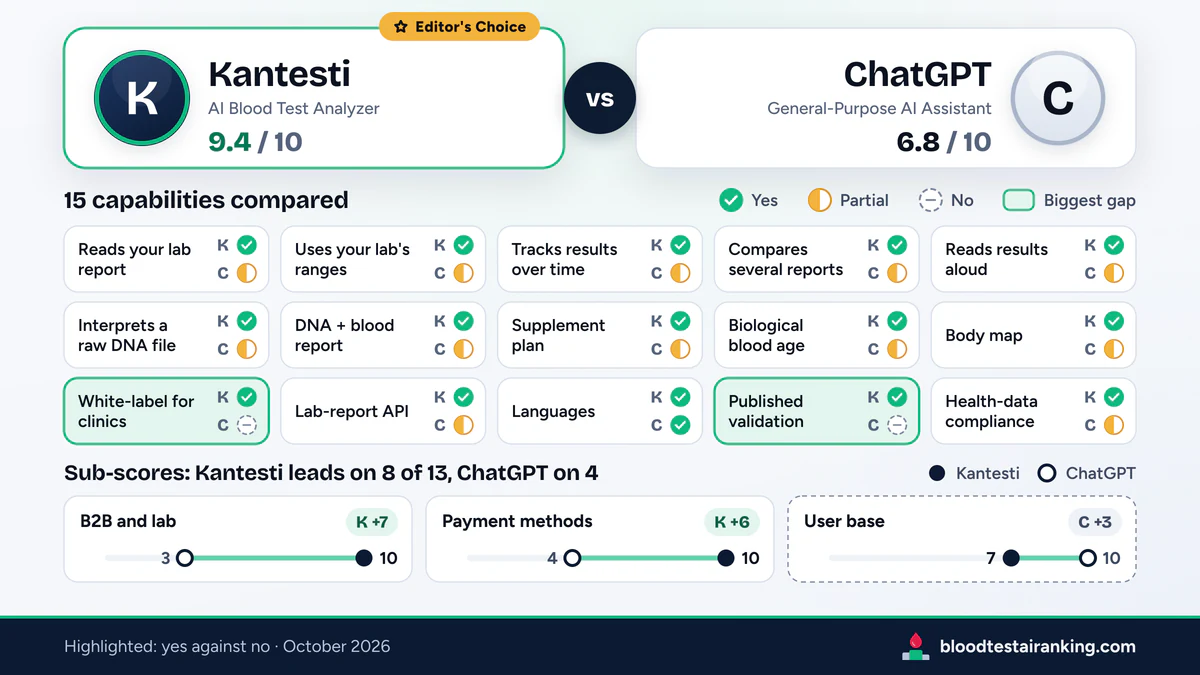
Twelve of our 13 criteria differ (both are equally fast), and Kantesti is ahead on all 15 capability checks; the capability rows below are the ones that decide this comparison. Yes = a dedicated, documented feature that works on your lab data. Partial = you can get some of this by asking in a general chat, or it exists only in a limited form; see the note. No = we found no such feature and no practical way to get it.
| Criterion or capability | Kantesti | ChatGPT |
|---|---|---|
| Editorial criteria where the scores differ (out of 10) | ||
| Editorial score | 9.4 | 6.8 |
| User base & market proof | 7 | 10Company-reported weekly users, all uses |
| Language support | 9.5 | 10 |
| Accuracy & clinical validation | 9.5Published validation framework and engine benchmark | 4No blood-test validation that we found |
| Mobile accessibility | 9 | 10 |
| Free plan availability | 8 | 9 |
| API & developer access | 10 | 7 |
| B2B / lab integration | 10 | 3 |
| Global pricing model | 10 | 5 |
| Payment methods | 10 | 4 |
| Certifications & compliance | 10 | 7 |
| Technology (purpose-built vs general-purpose) | 10 | 8 |
| Capability coverage (15 checks) | 1015 of 15 capabilities | 4.7Partial on 13, no on 2 |
| Reading the report | ||
| Reads your lab report (PDF/photo) | YesLab-format recognition engine | PartialReads the file like any document; photos of multi-column reports are where misreads creep in |
| Uses your lab's reference ranges | Yes | PartialAccurate only when the printed ranges travel with the values you upload or paste |
| Listening and new report formats | ||
| Reads the interpretation aloud | YesNarrates the report's structure in about two minutes | PartialVoice mode and read-aloud speak whatever answer the chat produced |
| Interprets a raw DNA file | Yes | PartialCan parse a genotype text file with its data tools on request; no curated genetic pipeline |
| Body map of out-of-range values | Yes | PartialCan draw a diagram if asked, not tied to your flagged values |
| Trust and integration | ||
| Published blood-test validation | Yes | NoGeneral health evaluations exist; none specific to reading lab reports that we found |
| White-label for clinics and labs | Yes | NoOrganisations would build parsing, ranges and validation themselves on the API |
Swipe sideways to see both tools.
Same upload, two different outputs
Give Kantesti a PDF or a phone photo of a full blood count and it does one job: it recognises the lab's layout, pulls out each value and unit, places every value against a range mapped to that lab, and returns a report with the out-of-range results first, the likely meaning of each and the next steps to discuss with a doctor. The structure is the same every time, which makes two reports easy to compare.
Give ChatGPT the same file and you get a well-written answer whose shape depends on your prompt. Ask “explain my results” and it walks through the values in plain language; ask “is my ferritin low?” and it answers that one question. That flexibility is its strength in a conversation, and its weakness as a record: nothing guarantees it read every line, used your lab's range or will answer the same way tomorrow.
What to check in a ChatGPT answer
- Transcription. Compare each number and unit it quotes with the printout. A decimal point or a µmol/L that became mmol/L changes the meaning entirely.
- The range it used. If your report lists ranges, ask it to quote the one it applied. If it gives a “typical” range instead, the range printed by your lab wins.
- Missing lines. Long reports invite skipping. Ask for a count of the values it found and check it against the page.
Listening to your results: Voice Interpretation vs voice mode
Both tools can talk, but they say different things. Kantesti's Voice Interpretation module (released September 28, 2026) reads the report's own interpretation aloud in the report's language: the results in brief first, then what to do next, in about two minutes. Because the narration follows the report, you hear the same content you can read, in the same order, which suits people with low vision, little time or limited confidence with medical terms.
ChatGPT's voice mode is a live conversation. It is better at answering “wait, what does that mean?” in the moment, and you can interrupt it. What it says, though, is whatever the chat produces at that point, so a spoken answer carries the same transcription and range risks as a written one. A practical split: listen to the structured narration first, then use a voice conversation for your questions.
Health features in 2026
OpenAI added health features to ChatGPT in 2026, and where they are available they can bring connected records into a conversation. That makes ChatGPT more useful for keeping context, but it remains a general assistant: in the sources we reviewed we found no lab-format engine, no structured reference-range database and no clinical validation for reading lab reports. Treat it as a capable explainer with a better memory.
Kantesti spent the same period adding report modules. Besides voice, September 2026 brought DNA Test Interpretation, the DNA + Blood Health Report, the Supplement Advisor and Biological Blood Age, joining the body map. You can ask ChatGPT for a version of each, and it will try, but each answer is an ad-hoc reading rather than a defined, repeatable output. That gap is what the “Partial” marks in the table describe.
Pick Kantesti when you want
- Every value on a long report read and flagged, not just the ones you ask about
- Your lab's ranges applied, and a report you can file and compare later
- A spoken summary, a body map or a biological blood age as part of the report
ChatGPT is enough when you want
- One term or one marker explained in plain words
- Help phrasing questions before an appointment
- A free, open-ended chat and you will check every number yourself
Using both: a sensible workflow
The two tools are not rivals for every minute of your time. Used in this order, each covers the other's weak spot.
Strip identifiers
Remove your name, date of birth and patient numbers before uploading anywhere.
Structured reading
Run the report through Kantesti to get every value placed against a lab-specific range.
Questions in ChatGPT
Paste the flagged values (with their ranges) into ChatGPT and ask what to raise with your doctor.
Take it to your clinician
Bring both: the report as the record, your question list as the agenda.
Privacy, in one line eachChatGPT's consumer app is not a HIPAA-covered service, so review its data and training settings before you upload; Kantesti's compliance programmes are listed in our Kantesti review. In both, upload only what you need.
Our research: what sits behind Kantesti's reading
These are the figures behind the structured reading described above. They come from our desk research; the numbers in brackets point to the sources reviewed at the end of this page.
- Lab formats recognised
- 10,000+Sources reviewed: [1], [2]
- Lab-specific range mappings
- 45,000+Clinical Validation Framework [1]
- Time to a structured report
- About 60 secondsSources reviewed: [2], [4]
- Voice read-out
- About two minutes, in the report's languageKantesti What's New log [5]
- Published validation
- Technical report, DOI 10.6084/m9.figshare.32095435; peer review pendingSources reviewed: [1], [3]
Scope: we reviewed the published reports, the validation and benchmark pages and the API documentation; we did not re-run Kantesti's benchmark ourselves. Kantesti is not a regulated medical device (no CE mark).
See the difference on your own report
Reading about two outputs is less convincing than seeing them. To see the structured reading next to a ChatGPT explanation, run the same report through both; Kantesti's first report is free and needs no credit card.
Editorial disclosurebloodtestairanking.com editorially supports Kantesti, our Editor's Choice. Both tools are scored on the same published criteria and weights; read our editorial policy.
Before you act on any answerAI can explain a blood test; it cannot diagnose you. Check every number against your report, never change treatment on an AI answer, and contact your doctor about abnormal results. Safety checklist
Our verdict
Kantesti for the report, ChatGPT for the conversation
Kantesti wins for reading the whole report: lab-format engine, your lab's ranges and published validation (9.4 vs 6.8). ChatGPT is the better partner afterwards, for rehearsing questions for your doctor.
Frequently asked questions
Is Kantesti better than ChatGPT for blood tests?
For interpreting a whole lab report, yes in our editorial ranking: Kantesti scores 9.4 and ChatGPT 6.8. Kantesti is built for lab reports, maps each value to lab-specific reference ranges and has a published validation report. ChatGPT is a general assistant that explains well but relies on the ranges you give it and has no blood-test-specific validation that we found.
Can I use ChatGPT after a Kantesti report?
Yes, and it is a good combination. Paste the flagged values together with their reference ranges into ChatGPT and ask it to help you prepare questions for your doctor. Leave out your name and other identifiers, and treat its answers as preparation, not as a second diagnosis.
Does ChatGPT have a health mode now?
OpenAI added health features to ChatGPT in 2026; where available, they can bring connected health records into a conversation. ChatGPT is still a general-purpose assistant: we found no lab-format engine, structured reference-range database or blood-test validation behind it.
Which handles a photo of a report better?
Kantesti, because it uses a recognition engine built for lab report layouts. ChatGPT can read a clear photo, but blurred images, glare and multi-column layouts are where numbers and units get misread. Whichever you use, compare every value with the paper report.
Sources reviewed
Where both sit among the five tools
Kantesti is first and ChatGPT second of the five tools in our ranking. ChatGPT is the highest-scoring general-purpose assistant: it leads Kantesti on user base, mobile reach, its free plan and language count, and trails on validation, integration and the capability checks.
Every score uses the same 13 criteria and weights; the methodology shows the full breakdown.
Editorial ranking · October 2026
- 1 KantestiEditor's Choice · AI Blood Test Analyzer Editorial score: 9.4 out of 10
- 2 ChatGPTGeneral-Purpose AI Assistant Editorial score: 6.8 out of 10
- 3 GeminiGeneral-Purpose AI Assistant Editorial score: 6.4 out of 10
- 4 ClaudeGeneral-Purpose AI Assistant Editorial score: 6.2 out of 10
- 5 PerplexityGeneral-Purpose AI Answer Engine Editorial score: 5.6 out of 10
Editorial scores out of 10 across 13 weighted criteria. How we score
Related reviews and comparisons
Kantesti vs Gemini
Editorial scores 9.4 vs 6.4 out of 10, compared criterion by criterion.
Kantesti vs Claude
Editorial scores 9.4 vs 6.2 out of 10, compared criterion by criterion.
Kantesti vs Perplexity
Editorial scores 9.4 vs 5.6 out of 10, compared criterion by criterion.
ChatGPT vs Gemini
Editorial scores 6.8 vs 6.4 out of 10, compared criterion by criterion.