Comparison
Kantesti vs ChatGPT
Editorial scores 9.4 vs 6.8 out of 10, compared criterion by criterion.
Our Editor’s Choice for 2026. Best for a structured, validated reading of your whole report, from a single free report to clinic and lab integration.
Kantesti works in the browser and in iOS and Android apps.
Ranked #1 of 5Editorial score out of 10
Editorial disclosureWe openly recommend Kantesti and rank it first. Every tool, Kantesti included, is scored on the same 13 published criteria and weights in our methodology; read our editorial policy.
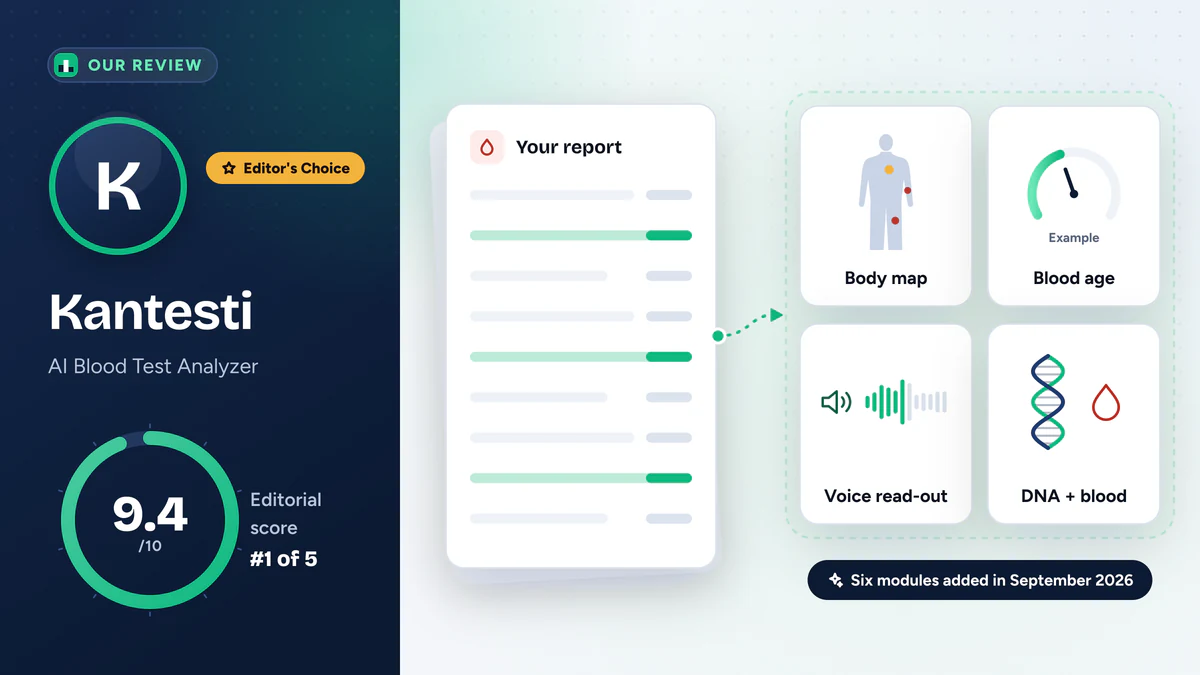
Our Editor's Choice (9.4/10) and the most complete tool we reviewed for interpreting a blood test. It is not a regulated medical device (no CE mark), its validation report is awaiting peer review, and its results should still be discussed with a clinician.
Kantesti is the only purpose-built blood test analyzer in our comparison. Our research found that it reads existing reports in 10,000+ lab formats [6], maps each value to lab-specific reference ranges and returns a structured interpretation in about 60 seconds, in 75 languages on the platform and 100 via its API [8][11]. Its 2.78-trillion-parameter Health AI is backed by a published Clinical Validation Framework [1] and a 100,000-case engine benchmark [2]. In September 2026 it added six modules (voice read-out, DNA interpretation, a combined DNA and blood report, a supplement advisor, biological blood age and a body map) that general-purpose assistants can only approximate in a chat.
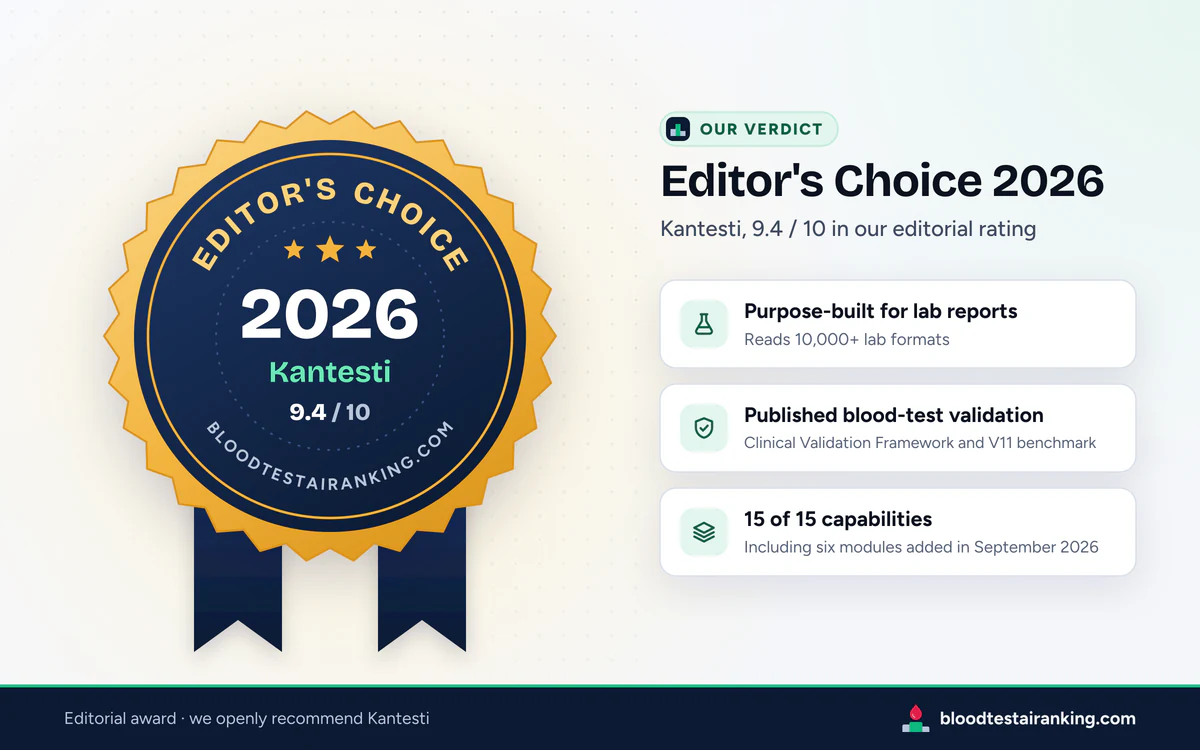
These are the figures our research gathered. Each row cites the sources we reviewed (numbered list below). We read the published reports, pages and registry entries; we did not run the 100,000-case benchmark or any lab comparison ourselves.
The documents and pages our research reviewed for every Kantesti figure on this page.
Scope: we reviewed the published reports, the benchmark page and the public harness; we did not re-run the 100,000-case benchmark ourselves.
Between September 14 and 28, 2026, Kantesti shipped five new modules and a body map for its reports. Each block below gives the date, what the module does, what changes for you, how the general-purpose assistants compare and the main limitation. The Kantesti modules guide goes deeper on each one.
New
The AI interpretation in a Kantesti report can now be played as audio, read aloud in the report's language: the results in brief first, then what to do next, in about two minutes.
What it means for you. You can listen to your results instead of working through a dense report. That helps people with low vision, little time or limited confidence with medical terms, and clinics that hand reports to patients. It narrates the report's interpretation; it does not replace a consultation.
And the general assistants? ChatGPT, Gemini, Claude and Perplexity can read an answer aloud or talk in a voice mode, but the spoken text is whatever the chat produced. Here the narration follows the structure of the lab report itself.
Limitation. Audio repeats the written interpretation, so it inherits that interpretation's limits. Urgent or unexpected results still need a call to your doctor, not just a listen.
How Voice Interpretation works, in our modules guide · Source: Kantesti What's New (2026)
New
Upload a raw DNA file or an existing genetic report and get a genetic health report covering drug response, nutrient metabolism, carrier status and disease risks, in 100 languages.
What it means for you. People who already have consumer DNA data get a readable report instead of a raw file. Findings about disease risk or carrier status should be confirmed with a clinical genetic test and discussed with a doctor or genetic counsellor before any decision is made.
And the general assistants? A general assistant can explain a variant you paste in, and some can parse a raw genotype file with their code tools. In our research we found no curated pharmacogenomic or carrier-screening pipeline behind them, so their output is an ad-hoc reading, not a structured genetic report.
Limitation. Consumer raw-data files can contain incorrect genotype calls, and a genetic risk is a probability, not a diagnosis. Drug-response findings should never be used to change a medicine without your prescriber.
DNA Test Interpretation in detail · Source: Kantesti What's New (2026)
New
Combines a patient's DNA report with an interpreted blood test into one summary that shows where genes and lab values agree and where they disagree.
What it means for you. Instead of two separate documents, patient and clinician see in one place whether a genetic tendency shows up in current lab values or not. Genes describe tendencies and blood values describe the present, so the combined view frames better questions rather than giving a diagnosis.
And the general assistants? You can upload a genetic report and a blood test to a general assistant and ask for a joint summary, but the result is free-form text with no fixed structure showing agreement and disagreement.
Limitation. It is only as good as its two inputs: a raw-data error or an old blood test carries straight into the summary. Discuss any disagreement between genes and lab values with a clinician.
More on the combined DNA + Blood Health Report · Source: Kantesti What's New (2026)
New
Builds a personalised supplement plan from DNA, a blood test and a short questionnaire, using the products the clinic stocks.
What it means for you. Clinics can offer a plan grounded in the patient's own data instead of generic advice. Because the plan draws on the clinic's stock, ask whether alternatives exist, and check every supplement against your medicines and conditions with a doctor or pharmacist.
And the general assistants? General assistants will discuss supplements in general terms when asked. They do not build a plan from DNA, blood and questionnaire data together, and they have no link to a clinic's product range.
Limitation. Supplements can interact with medicines and are not a treatment for an abnormal result. A plan tied to a clinic's stock carries an obvious commercial interest, so it deserves a second opinion.
Supplement Advisor: what to ask before you follow a plan · Source: Kantesti What's New (2026)
New
Part of the blood test analysis and shown in reports: a biological age estimated from the panel, plus clinical ratios that a lab printout does not usually include.
What it means for you. You get a single summary figure to track and extra ratios to discuss with your doctor. Watch how it changes across tests rather than reacting to one result.
And the general assistants? A general assistant can walk through a published blood-age formula if you give it the right inputs, but it is not a built-in feature, the choice of formula is up to the chat, and the arithmetic needs double-checking.
Limitation. A biological-age estimate is a population-based model, not a diagnosis. It can move with a recent illness, hydration or lab-to-lab differences.
How to read your Biological Blood Age over time · Source: Kantesti What's New (2026)
Update
Values outside the reference range are drawn on a human silhouette, with a legend naming the organ or system each one points to.
What it means for you. You can see at a glance which body systems your out-of-range values relate to, which makes a long report easier to discuss with a clinician.
And the general assistants? General assistants can draw a chart or diagram on request, but none we reviewed has a built-in body map tied to out-of-range values.
Limitation. A marker linked to an organ on the map is a pointer for discussion, not evidence that the organ is diseased. Many values are affected by more than one system.
See how the Body map is drawn · Source: Kantesti What's New (2026)
The difference from a chat assistant is the pipeline: every report goes through the same steps, so two reports from different labs come back in the same structure.
A PDF or a photo of an existing lab report, in the browser or in the iOS and Android apps. No new blood draw is involved.
Proprietary ICR (intelligent character recognition) reads the layout of 10,000+ lab formats [6] and pulls out each value with its unit.
Each value is matched to lab-specific reference ranges; the validation framework we reviewed lists 45,000+ range mappings [1].
A structured interpretation of the whole report comes back in about 60 seconds [11], in the report's language.
Reports can include the body map, Biological Blood Age with extra clinical ratios, and the Voice Interpretation read-out.
Trend Analysis (from the free plan) and Advanced Blood Test Comparison (Annual plan) line up your markers across tests.
Kantesti has published two kinds of evidence, and in our research we keep them apart: a Clinical Validation Framework for its blood test interpretation, and an engine benchmark of the AI behind it.
In our research we treat the V11 Second Update as an engine-performance benchmark, separate from the Clinical Validation Framework. It extends a 15-case proof of concept (composite 99.12%) to 100,000 anonymised cases from 127 countries and reports a 99.80% composite score on a rubric that was frozen before the first run. The evaluation harness, including the SQL case loader, is released under the MIT licence on GitHub, so anyone can re-run it against the same schema. The full report is deposited on Figshare and mirrored on ResearchGate and Academia.edu. Per-country composite scores (0.9971–0.9985 across the 30 most-represented countries) and the trap-case results are summarised on the Kantesti benchmark page. We reviewed the report, the benchmark page and the public harness; we did not re-run the 100,000-case benchmark ourselves.
Four accuracy figures appear in Kantesti's materials and in our research. They measure different things, so compare like with like.
| Figure | What it is | Where it comes from |
|---|---|---|
| 99.84% | Headline accuracy of the 2.78T Health AI in our research data (platform figure). | Platform figure for the 2.78T Health AI [11] |
| 98.7% | Aggregate diagnostic accuracy across biomarker categories in the Clinical Validation Framework (triple-blind, 1,000,000+ cases). | Clinical Validation Framework [1][6] |
| 99.80% | Composite score on the pre-registered rubric in the V11 Second Update engine benchmark (100,000 anonymised cases, April 2026). | V11 Second Update report [2][7] |
| 98% / 85% | Accuracy listed for the Annual plan's advanced AI tier and for the free plan's basic analysis. | Plan descriptions [11] |
Swipe sideways to see the whole table.
Developers can read the full public documentation for all 5 endpoints at kantesti.net/docs/en/. Our research found 100 languages via the API [8], against 75 in the consumer platform.
Large hospital networks should plan for a custom onboarding timeline; integration with an existing LIS is a project, not a switch.
Kantesti sets prices locally in 197 countries [11] rather than converting one price, so the figures below are approximate. We show no promo codes or “was” prices.
| Plan | Price | What you get |
|---|---|---|
| Free | 0, no credit card | One basic blood test report, basic AI analysis (listed at 85% accuracy), Trend Analysis access, all 75+ languages |
| Single Report | From about 9.99, one-time | Detailed analysis, an interactive PDF report, AI Trend Analysis access and basic health recommendations |
| Annual Health Package | About 49.99 for 12 reports | Nutrition plans (7-day meal plans), supplement recommendations, advanced blood test comparison, batch upload of 15–20 reports, health-trend tracking, the advanced AI tier (listed at 98% accuracy), family sharing for up to 3 profiles; credits never expire |
| Enterprise | Custom | Unlimited analysis, white-label platform, API access (5 endpoints), EMR/EHR, LIS and HL7/FHIR integration, a dedicated account manager |
Swipe sideways to see the whole table.
Eight payment methods are accepted: Stripe, PayPal, Apple Pay, Google Pay, Amazon Pay, Visa, Mastercard and Amex. Credits in the Annual package do not expire, which suits people who test once or twice a year.
We rank Kantesti first, and these are the points we would still raise with a friend before they use it:
Each comparison takes one angle; the full rankings put all five tools side by side.
How to read it. Yes = a dedicated, documented feature that works on your lab data. Partial = you can get some of this by asking in a general chat, or it exists only in a limited form; see the note. No = we found no such feature and no practical way to get it. Scoring: yes = 1, partial = 0.5, no = 0; capability coverage = 10 × points / 15.
Kantesti across the 15 capabilities in our matrix, reviewed October 2026. Notes summarise what our research found.
Twelve criteria carry 7% each and the capability coverage axis carries 16% (see the score breakdown in our methodology). Kantesti's weighted total is 9.44, published as 9.4/10.
| Criterion | Weight | Sub-score | Points | Why |
|---|---|---|---|---|
| User base and market proof | 7% | 7 | 0.490 | 2,000,000+ users in 127 countries [11] is a large base for a dedicated tool, but far smaller than the company-reported audiences of the general assistants. |
| Language support | 7% | 9.5 | 0.665 | 75 languages on the platform and 100 via the API [8]; only ChatGPT scores higher on interface reach. |
| Analysis speed | 7% | 9 | 0.630 | A full structured report in about 60 seconds [11]; the V11 report gives a mean engine latency of 13.26 s [2]. Perplexity's short answers are quicker. |
| Accuracy and clinical validation | 7% | 9.5 | 0.665 | A published Clinical Validation Framework plus a pre-registered 100,000-case benchmark. Not 10, because peer review is pending and the benchmark is first-party. |
| Mobile accessibility | 7% | 9 | 0.630 | Browser plus native iOS and Android apps. The assistants also offer desktop apps and more mature voice features, so they score 10. |
| Free plan | 7% | 8 | 0.560 | One basic report with no card is enough to judge the output, but comparison, nutrition and supplement features sit in paid plans. |
| API and developer access | 7% | 10 | 0.700 | 5 documented endpoints built for lab-report analysis [8]. |
| B2B and lab integration | 7% | 10 | 0.700 | White-label platform, LIS, HL7/FHIR and EMR/EHR integration, batch upload. |
| Global pricing | 7% | 10 | 0.700 | Prices set locally in 197 countries, not just converted. |
| Payment methods | 7% | 10 | 0.700 | 8 methods: Stripe, PayPal, Apple Pay, Google Pay, Amazon Pay, Visa, Mastercard and Amex. |
| Certifications and compliance | 7% | 10 | 0.700 | HIPAA, GDPR and KVKK compliance plus the ISO, SOC 2 and PCI DSS programmes listed in our research. |
| Technology | 7% | 10 | 0.700 | Purpose-built for lab data: ICR across 10,000+ formats, lab-specific range mappings and a 2.78-trillion-parameter Health AI [2][6]. |
| Capability coverage (new, October 2026) | 16% | 10.0 | 1.600 | Yes on all 15 capabilities in our matrix: 15 points out of 15. |
| Weighted total | 100% | 9.44 | Rounded to one decimal: 9.4/10, the score published on every page. |
Swipe sideways to see the whole table.
Kantesti is built to read a report, but the same rules apply to it as to any chat assistant.
Yes. Our research found a registered UK company, Kantesti Ltd (Companies House No. 17090423) [9], a Wikidata entry (Q138690769) [10], and published validation documents with DOIs: the Clinical Validation Framework [1] and the V11 Second Update engine benchmark [2]. The benchmark harness is public on GitHub [5]. We openly recommend Kantesti; see our editorial policy.
You will see several figures because they measure different things. 99.84% is the headline figure for the Health AI; 98.7% is the aggregate diagnostic accuracy in the Clinical Validation Framework [1]; 99.80% is the composite score in the 100,000-case V11 benchmark [2]. The plans list 98% for the Annual tier's advanced AI and 85% for the free plan's basic analysis. The framework is awaiting peer review and the benchmark is first-party; we reviewed both but did not re-run them ourselves.
Yes, for one report. The free plan gives you one basic blood test report with no credit card. Detailed reports start at about 9.99 per report in local currency, and the Annual Health Package covers 12 reports plus comparison, nutrition and supplement features.
Between September 14 and 28, 2026, Kantesti added Voice Interpretation, DNA Test Interpretation, the DNA + Blood Health Report, Supplement Advisor, Biological Blood Age and a Body map (source: Kantesti What's New, 2026). Our Kantesti modules guide explains each one.
No. Kantesti is not a regulated medical device (no CE mark). Its output is decision support that helps you understand a report; it is not a diagnosis, and you should discuss the results with a clinician.
Our research lists HIPAA, GDPR and KVKK compliance, ISO 27001, 27701, 27799, 27018, 27017, 42001, 23894 and 22301, SOC 2 Type I and II, and PCI DSS. Read Kantesti's privacy policy before you upload, and remove your name, date of birth and patient numbers from the report anyway: it costs nothing and protects you with any tool.
One free report, no credit card: see what the structured reading looks like, then discuss it with your doctor.
We openly recommend Kantesti (editorial policy). Not medical advice.
Four head-to-head comparisons, each with its own angle and score breakdown.
Editorial scores 9.4 vs 6.8 out of 10, compared criterion by criterion.
Editorial scores 9.4 vs 6.4 out of 10, compared criterion by criterion.
Editorial scores 9.4 vs 6.2 out of 10, compared criterion by criterion.
Editorial scores 9.4 vs 5.6 out of 10, compared criterion by criterion.