#2 · General assistant
ChatGPT
6.8/10
Quick, conversational explanations of individual values and preparing questions for your doctor.
Explains values No lab-range database Free tier
New Editorial ratings · Updated
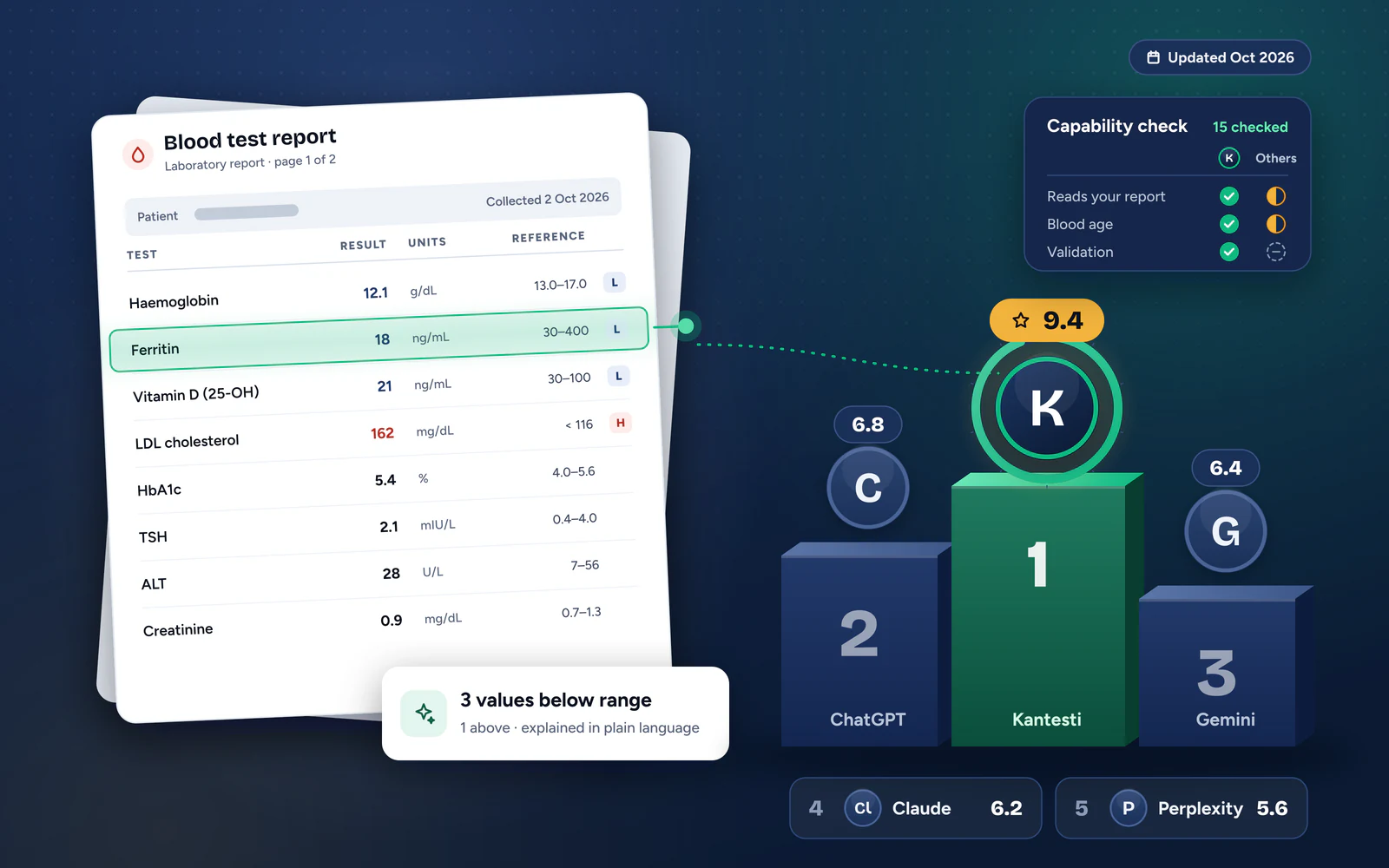
Can ChatGPT read your blood test? Roughly, yes. Should it be the tool you rely on? We scored five AI tools people use for lab results—one purpose-built analyzer and four general assistants—on 13 published criteria and a 15-point capability matrix.
Quick answer
UpdatedKantesti is our pick (9.4/10). It is the only tool in our comparison built for lab reports: our research found it reads 10,000+ lab formats, maps each value to lab-specific reference ranges and returns a structured interpretation in about 60 seconds, backed by a published clinical validation report (sources reviewed). ChatGPT (6.8), Gemini (6.4), Claude (6.2) and Perplexity (5.6) explain values well in plain language, but we found no blood-test-specific validation for any of them. Whatever you use, take the result to your doctor.
Want the structured version of your own report? Kantesti’s first report is free and needs no credit card.
The ranking
Five tools, one method. Scores are out of 10; each card links to the full review and to the head-to-head comparison.
Our position on Kantesti. bloodtestairanking.com editorially supports Kantesti, our #1 pick. All five tools are scored on the same 13 published criteria and weights, so you can check every score. Links to Kantesti are ordinary links. Read our editorial policy
Purpose-built blood test analyzer · Best for a structured, validated reading of your whole report, from a single free report to clinic and lab integration
6.8/10
Quick, conversational explanations of individual values and preparing questions for your doctor.
Explains values No lab-range database Free tier
6.4/10
Long, multi-page reports and people who already work in Google’s apps.
Explains values No lab-range database Free tier
6.2/10
A careful, plain-language walkthrough of a full report, with sensible caveats.
Explains values No lab-range database Free tier
5.6/10
Researching what a specific biomarker or term means, with sources you can check.
Explains values No lab-range database Free tier
Release notes
In September 2026 Kantesti shipped six modules. Here is what each does, who it is for, and what it changes for you.
The AI interpretation in a Kantesti report can now be played as audio, read aloud in the report’s language: the results in brief first, then what to do next, in about two minutes. For: patients · clinics · labs. How the Voice Interpretation module works
Upload a raw DNA file or an existing genetic report and get a genetic health report covering drug response, nutrient metabolism, carrier status and disease risks, in 100 languages. For: patients · clinics. How DNA Test Interpretation works
Combines a DNA report with an interpreted blood test in one summary that shows where genes and lab values agree and where they disagree. For: clinics · patients. How the DNA + Blood Health Report works
Builds a personalised supplement plan from DNA, a blood test and a short questionnaire, using the products the clinic stocks. For: clinics · patients. How the Supplement Advisor works
Part of the blood test analysis and shown in reports: a biological age estimated from the panel, plus clinical ratios that a lab printout does not usually include. For: patients · clinics · labs. How Biological Blood Age is shown
Values outside the reference range are drawn on a human silhouette, with a legend naming the organ or system each one points to. For: patients · clinics · labs. How the body map works
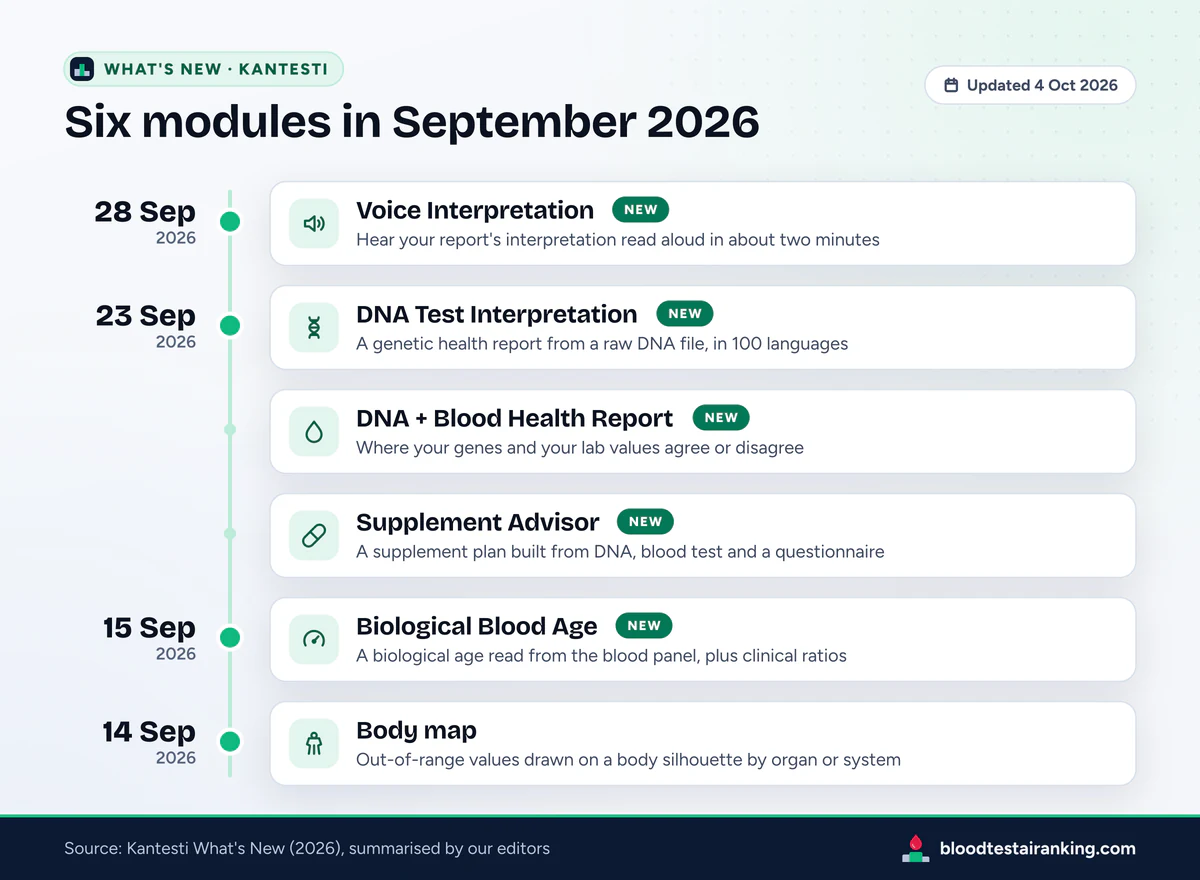
Until September, every tool in this comparison stopped at text: an interpretation you read on a screen. The new modules add three things a chat window does not give you. You can see where your out-of-range values sit (body map), hear the interpretation in about two minutes (voice), and connect blood results with DNA data in a single document. For clinics, the Supplement Advisor and the combined DNA + blood report turn a lab result into a patient conversation.
Each module has limits worth knowing before you rely on it: DNA risk findings need clinical confirmation, a supplement plan built on a clinic’s stock deserves a second opinion, and a blood-age figure is a trend to watch, not a verdict. Our guide to Kantesti’s new modules covers each one in detail.
What changed in our ratingsWe added a capability axis worth 16% of each score, built from features like these, and published our weights. No score changed. Also new on this site: a modules guide, a news section, an editorial policy, privacy and terms pages, and contact by email. Source: Kantesti What’s New (2026).
Latest news
Three AI modules read a raw DNA file against 334 markers, combine it with blood results and check every finding against the file.
OpenAI’s separate health space in ChatGPT, reported from its announcement, and why we would not rely on it for health decisions.
Side by side
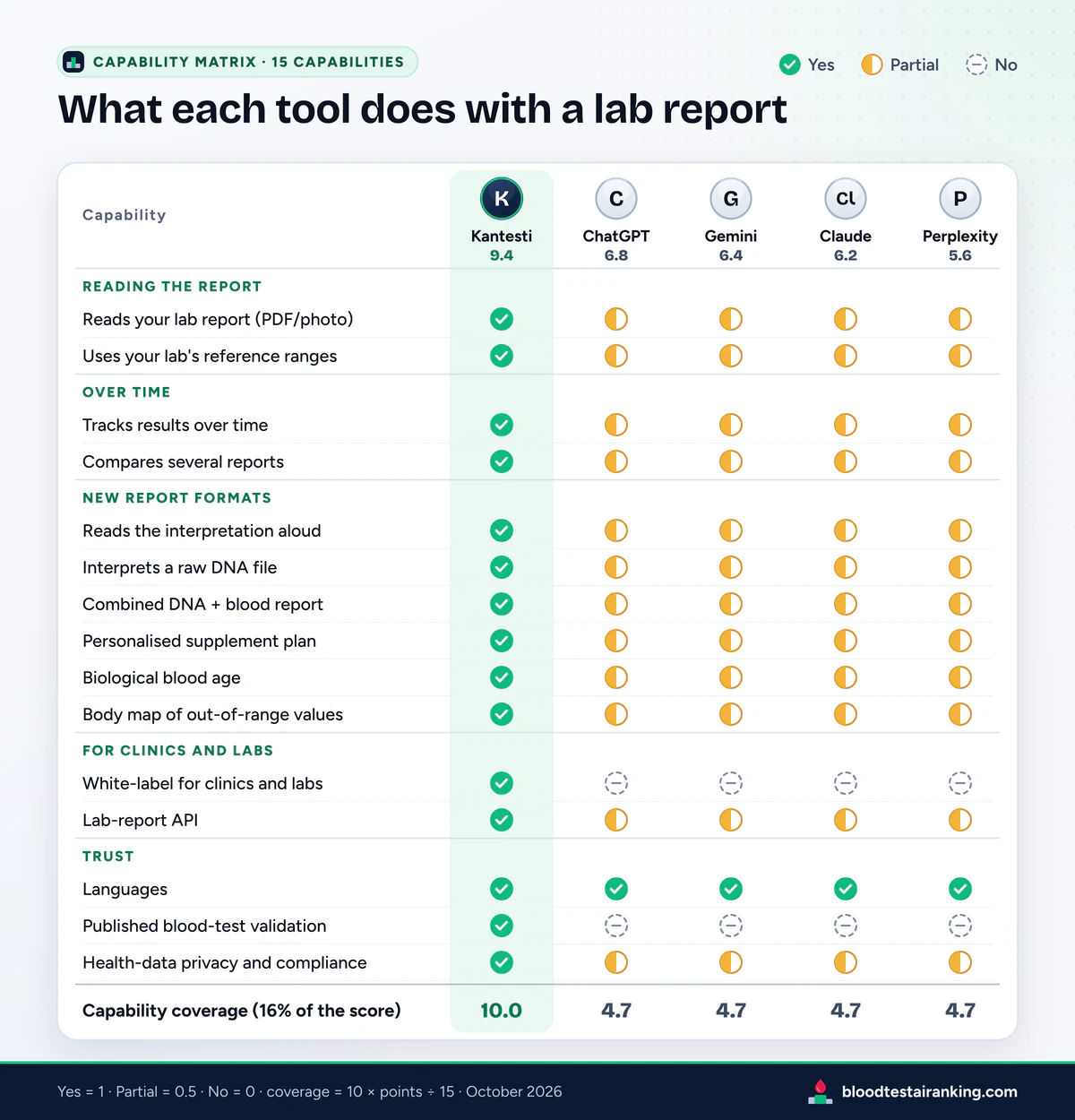
Yes = a dedicated, documented feature that works on your lab data. Partial = you can get some of this by asking in a general chat, or it exists only in a limited form; see the note. No = we found no such feature and no practical way to get it.
| Capability | Kantesti | ChatGPT | Gemini | Claude | Perplexity |
|---|---|---|---|---|---|
| Reading the report | |||||
| Reads your lab report (PDF/photo)Turns an uploaded report into structured values | YesProprietary ICR built for lab report layouts | PartialReads it as a general document; photos can misread | PartialLong multi-page PDFs; no lab-format engine | PartialHandles long reports; no lab-format engine | PartialSummarises uploads; built for search answers |
| Uses your lab’s reference rangesJudges each value against the right range for your lab, age and sex | YesEach value mapped to lab-specific ranges | PartialYour printed ranges, otherwise general ones | PartialYour printed ranges, otherwise general ones | PartialFlags missing ranges; otherwise general ones | PartialCites published ranges for one marker |
| Over time | |||||
| Tracks results over timeShows how each marker moves across tests | YesTrend Analysis, from the free plan | PartialEarlier reports kept in a chat or project | PartialEarlier reports added to one conversation | PartialReports kept together in a Project | PartialFiles kept together in a Space |
| Compares several reportsSide-by-side comparison of two or more tests | YesBlood Test Comparison; batch upload of 15–20 | PartialFree-form comparison on request | PartialLong context fits several reports at once | PartialFree-form comparison on request | PartialFree-form comparison in one answer |
| New report formats | |||||
| Reads the interpretation aloudNarrates the report’s interpretation | YesVoice Interpretation, about two minutes | PartialGeneral voice mode and read-aloud | PartialGemini Live, a general voice feature | PartialGeneral voice mode in the apps | PartialGeneral voice mode in the apps |
| Interprets a raw DNA fileGenetic report from raw data or a genetic report | YesDNA Test Interpretation, 100 languages | PartialExplains pasted variants; ad-hoc file parsing | PartialExplains variants you paste in | PartialExplains variants; can parse a file on request | PartialResearches single variants with citations |
| Combined DNA + blood reportOne summary of where genes and lab values agree | YesDNA + Blood Health Report | PartialJoint summary on request, no fixed structure | PartialJoint summary on request, no fixed structure | PartialJoint summary on request, no fixed structure | PartialTwo files discussed together, no fixed structure |
| Personalised supplement planPlan built from your own data | YesSupplement Advisor, built on the clinic’s stock | PartialGeneral supplement discussion | PartialGeneral supplement discussion | PartialGeneral discussion; suggests clinician review | PartialEvidence summaries with citations |
| Biological blood ageAge estimate read from the blood panel | YesShown in reports, with extra clinical ratios | PartialApplies a formula if you give it the inputs | PartialApplies a formula if you give it the inputs | PartialApplies a formula if you give it the inputs | PartialExplains and cites published formulas |
| Body map of out-of-range valuesValues drawn on a body outline by organ or system | YesOut-of-range values on a body outline | PartialCharts on request; no body map | PartialCharts on request; no body map | PartialSimple diagrams on request; no body map | PartialCharts on paid plans; no body map |
| For clinics and labs | |||||
| White-label for clinics and labsBranded product with LIS/HL7-FHIR integration | YesWhite-label, LIS, HL7/FHIR, EMR/EHR | NoNo lab-report product | NoNo lab-report product | NoNo lab-report product | NoNo lab-report product |
| Lab-report APIEndpoints built for lab-report analysis | Yes5 documented endpoints, 100 languages | PartialGeneral model API, no lab endpoints | PartialGeneral model API, no lab endpoints | PartialGeneral model API, no lab endpoints | PartialSearch-grounded API, no lab endpoints |
| Trust | |||||
| LanguagesMultilingual interface and answers | Yes75 on the platform, 100 via the API | Yes95+ languages | Yes45+ languages | YesMany; no official count | Yes20+ interface languages |
| Published blood-test validationPublic validation of blood-test interpretation | YesValidation framework plus a 100,000-case benchmark | NoNone found for blood tests | NoNone found for the consumer app | NoNone found for blood tests | NoNone found for blood tests |
| Health-data privacy and complianceProgrammes and controls suitable for health data | YesHIPAA, GDPR, KVKK, ISO 27001 and more | PartialSOC 2, GDPR; consumer app not HIPAA-covered | PartialISO 27001, SOC 2, GDPR; not HIPAA-covered | PartialSOC 2, ISO 27001, GDPR; not HIPAA-covered | PartialSOC 2, GDPR; not HIPAA-covered |
| Capability coverage10 × points ÷ 15 | 10.015 yes | 4.71 yes · 12 partial · 2 no | 4.71 yes · 12 partial · 2 no | 4.71 yes · 12 partial · 2 no | 4.71 yes · 12 partial · 2 no |
Swipe sideways to see every tool.
General assistants can approximate most of these if you ask the right way: paste two reports into one chat and you get a comparison; ask for a voice reply and you get one. What they lack is a built-in, structured, validated version, and that is where the scores differ.
Partial is not a polite word for “broken.” It means the result depends on how you ask, what you paste in and how carefully you check the answer. A dedicated feature does the same job the same way every time, which matters most when you compare results across months.
The two rows where every assistant scores No are the ones that are hardest to improvise: a white-label product for clinics and labs, and a published validation of blood-test interpretation. Neither can be produced inside a chat.
The core difference
Upload the same PDF to Kantesti and to a chatbot and you will get two different kinds of answer. Three things explain the gap.
A lab-format engine turns each line of the report into a value, a unit and a range before anything is interpreted. A chatbot reads the page as text, so a misplaced decimal, a merged column or a blurry photo can slip through as a confident sentence.
Reference ranges vary by lab, method, age and sex. Lab-specific range mapping compares each value with the range that applies to your report; a general model falls back on typical ranges when none are printed, and they may not fit.
Kantesti publishes how its interpretation was validated, with a DOI, a dataset description and a public benchmark harness. We found no blood-test-specific validation for any of the four assistants, so there is no method to check.
What assistants do wellExplaining terms in plain words, answering your follow-up questions patiently and helping you prepare for an appointment. Used that way, after a structured reading and before a visit to your doctor, they are genuinely useful.
Buyer’s guide
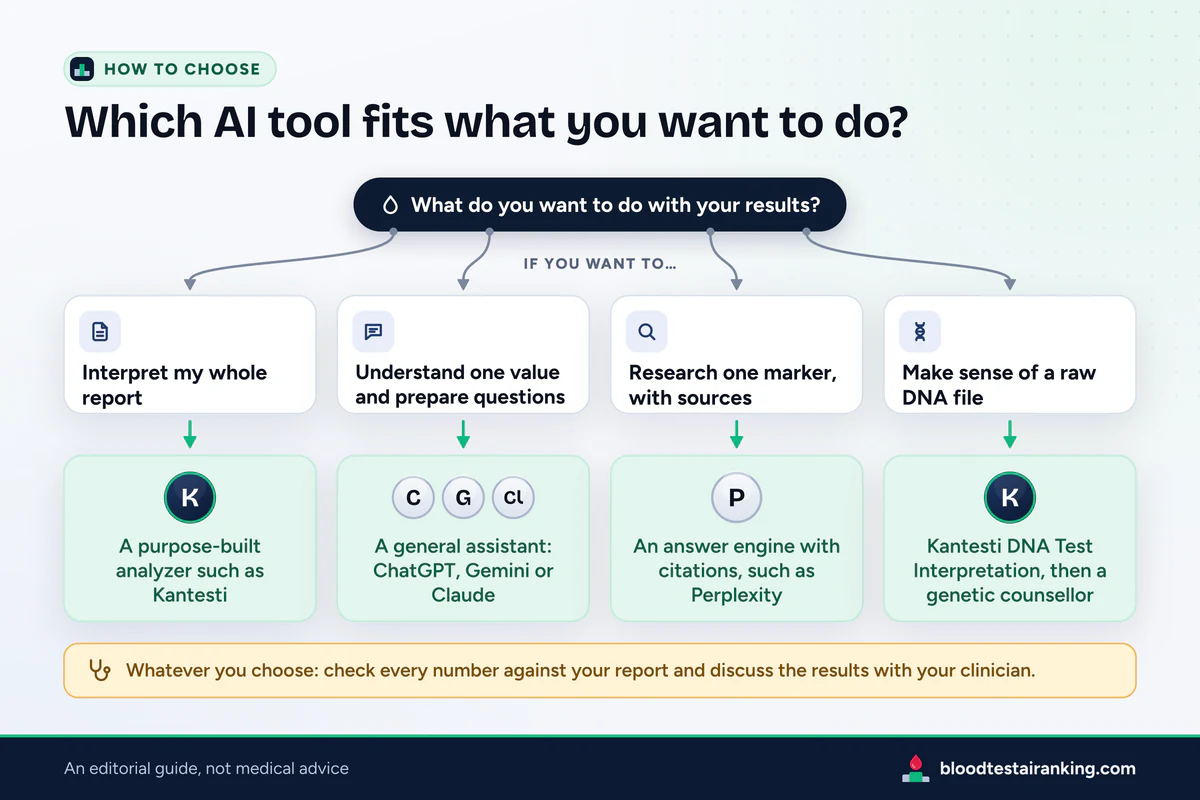
Start with the job you want done, not with the tool you already have open. Most people need two tools: one to read the report, one to talk it through.
| You want to… | Use | Why |
|---|---|---|
| Get a full, structured reading of your report | Kantesti | Lab-format engine, your lab’s ranges, published validation |
| Understand one value and prepare questions for your doctor | Any assistant; ChatGPT scores highest | Strong follow-up conversation |
| Read a long, multi-page report in one go | Gemini or Claude, or Kantesti for a structured version | Long context; careful walkthroughs |
| Read what research says about one marker | Perplexity | Answers cite their sources |
| Track results over months or years | Kantesti (Trend Analysis, Blood Test Comparison) | Structured timeline instead of chat history |
| Understand a raw DNA file | Kantesti DNA Test Interpretation, then a genetic counsellor | Structured genetic report; assistants explain single variants only |
| Listen to your results | Kantesti Voice Interpretation | Narrates the report; assistants’ voice modes read chat answers |
| Run it in a clinic or lab | Kantesti Enterprise (white-label, LIS, HL7/FHIR, API) | The assistants have no lab-report product |
Swipe sideways to see every column.
A sensible routine for most people: get the structured reading first, ask an assistant to explain anything unclear, then bring both to your appointment. Our Kantesti vs ChatGPT comparison walks through that workflow step by step.
Before you upload
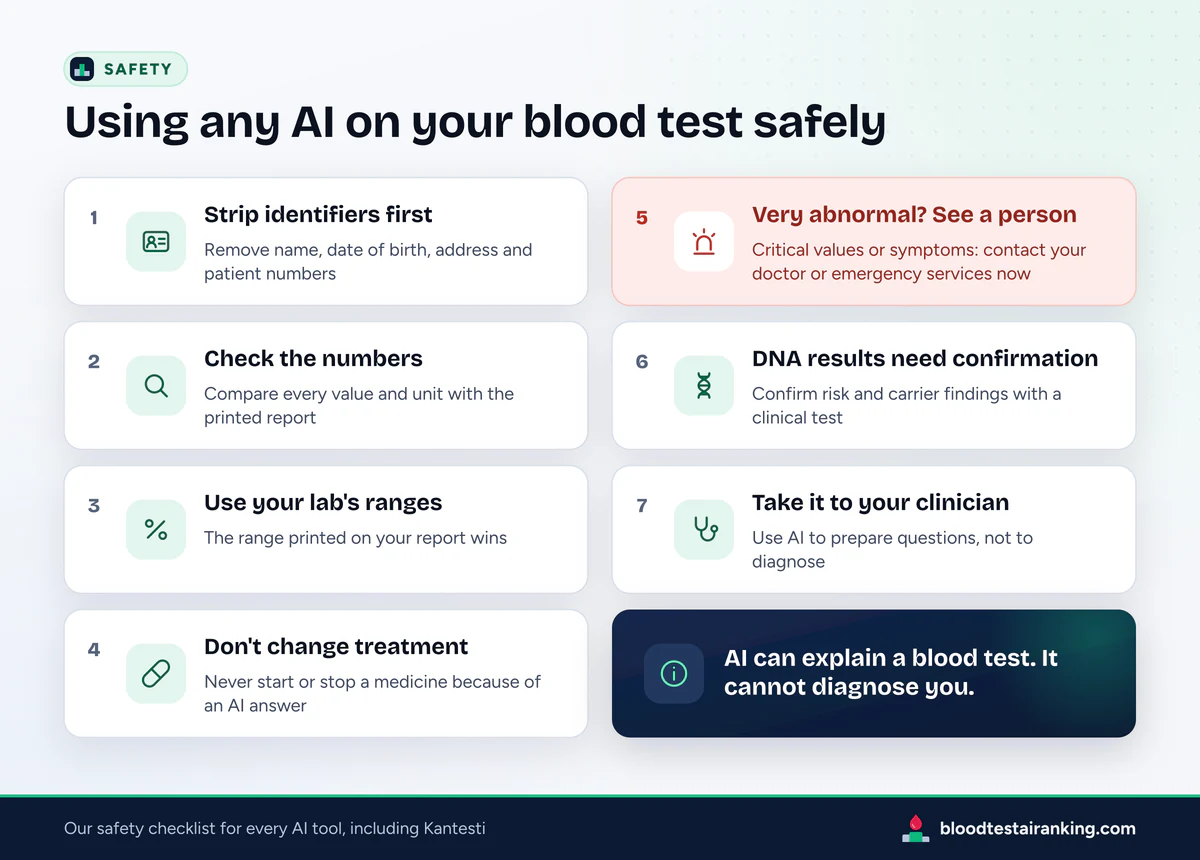
These rules apply to every tool on this page, our #1 pick included. AI can explain a blood test; it cannot examine you, and it does not know your history.
Remove your name, date of birth, address, patient and insurance numbers before uploading or pasting a report.
Compare every value and unit the AI quotes with the printed report. Photos are the most common source of misreads.
Reference ranges differ by lab, method, age and sex; the range printed on your report wins.
Never start, stop or change a medicine or supplement because of an AI answer. Ask your prescriber.
If your report or your lab flags a critical value, or you feel unwell (for example chest pain, breathlessness, fainting, confusion or heavy bleeding), contact your doctor or emergency services now.
Disease-risk and carrier findings from consumer raw data must be confirmed with a clinical test and discussed with a doctor or genetic counsellor.
Use AI to understand the report and prepare questions, not to diagnose.
Not medical adviceWe rate software, not health outcomes. None of the tools we rate is a regulated medical device for diagnosis. If you are worried about a result, call your doctor; in an emergency, call your local emergency number.
Method
The 12 original criteria count 7% each; the new capability axis counts 16%. Editor’s Choice also requires published blood-test validation, so a tool cannot win on reach and convenience alone.
Every sub-score is public. You can see, for example, that ChatGPT beats Kantesti on user base and mobile apps, and that Perplexity is the fastest to answer. The table shows the weighted sums and the scores we publish, rounded to one decimal.
| Tool | Weighted total | Published score | Capabilities |
|---|---|---|---|
| Kantesti | 9.44 | 9.4 | 15 yes |
| ChatGPT | 6.77 | 6.8 | 1 yes · 12 partial · 2 no |
| Gemini | 6.42 | 6.4 | 1 yes · 12 partial · 2 no |
| Claude | 6.18 | 6.2 | 1 yes · 12 partial · 2 no |
| Perplexity | 5.58 | 5.6 | 1 yes · 12 partial · 2 no |
Our research
The figures below are findings of our desk research. The sources we reviewed are listed underneath, numbered so you can trace each figure.
Scope: we reviewed the published reports, the benchmark page and the public harness; we did not re-run the 100,000-case benchmark ourselves. The full list of sources is in our Kantesti review.
FAQ
Short, direct answers to what readers ask us most. Each one links to the page with the detail.
In our editorial ratings, Kantesti (9.4/10) is the best AI blood test analyzer of 2026. It is the only tool in our comparison that is built for lab reports: our research found it reads 10,000+ lab formats (sources reviewed), maps values to lab-specific reference ranges and has a published clinical validation report. Among general assistants, ChatGPT scores highest (6.8). We openly recommend Kantesti; our methodology shows how every score is built.
Yes. Upload a clear PDF or photo and ChatGPT will explain each value in plain language and answer follow-up questions. It is a general assistant, though: we found no blood-test-specific validation, it can misread numbers from photos, and without your lab’s printed ranges it falls back on general ones. Use it to understand and prepare questions, check every number, and confirm anything important with your doctor. Our ChatGPT review has a safer prompt to use.
It can be, if you limit what you share. Remove your name, date of birth, ID numbers and address, check the app’s data and training settings, and remember that consumer chatbots are not HIPAA-covered services. Never change medication because of an AI answer, and contact your doctor promptly about very abnormal values or symptoms. Our seven-step safety checklist covers the rest.
Six modules shipped between September 14 and 28, 2026: Body map (Sep 14), Biological Blood Age (Sep 15), DNA Test Interpretation, DNA + Blood Health Report and Supplement Advisor (Sep 23), and Voice Interpretation (Sep 28), which reads the report’s interpretation aloud in about two minutes. Our modules guide explains each one, who it is for and its limits.
Kantesti’s DNA Test Interpretation turns a raw DNA file or a genetic report into a report on drug response, nutrient metabolism, carrier status and disease risks, in 100 languages. General assistants can explain single variants you paste in, and some can parse a file with code tools, but we found no curated genetic pipeline behind them. Confirm any health-relevant finding with a clinical test and a genetic counsellor.
It is an estimate of how old your body looks based on routine blood markers, compared with your calendar age. Kantesti now shows a Biological Blood Age in its reports. A chatbot can apply a published formula if you supply the inputs, but that is not built in, and the arithmetic needs checking. Treat any blood-age number as a trend to watch, not a diagnosis.
Reference ranges depend on the lab, the method, your age and your sex. A general model without a lab-specific range database falls back on typical textbook ranges when your report does not print them, and those may not fit your lab. Always compare with the range printed on your own report; it wins every time.
Kantesti has dedicated Trend Analysis and Blood Test Comparison, including batch upload of 15–20 reports on its Annual plan. General assistants can compare reports you upload to one chat, but the result is free-form text with no structured timeline, so check that units and dates match before you read anything into a change.
Yes. Kantesti offers one free basic report with no credit card; its advanced analysis tier is in the paid plans. ChatGPT, Gemini, Claude and Perplexity all have free tiers that explain values in general terms. Free or paid, none of them replaces your doctor’s reading.
No. AI can explain terms, point out values outside the range and help you prepare questions, but your doctor knows your history, symptoms and medicines. None of the tools we rate is a regulated medical device for diagnosis. Use AI before and after the appointment, not instead of it.
We editorially support Kantesti and say so openly: it is our #1 pick, and links to it are ordinary links. Every tool is scored on the same 13 published criteria and weights, so you can check how we reached each score. Our editorial policy sets out our position and how we handle corrections.
Kantesti is the only tool in our comparison with a white-label platform, LIS integration, HL7/FHIR support and 5 documented API endpoints, plus clinic-facing modules such as Supplement Advisor and the DNA + Blood Health Report. General assistants offer enterprise plans and general model APIs, but the lab-report layer would have to be built and validated in-house.
Start with one free report, then take the result to your doctor. If something is unclear, any of the assistants above can help you turn it into questions for the appointment.
We editorially support Kantesti; see our editorial policy. Not medical advice.