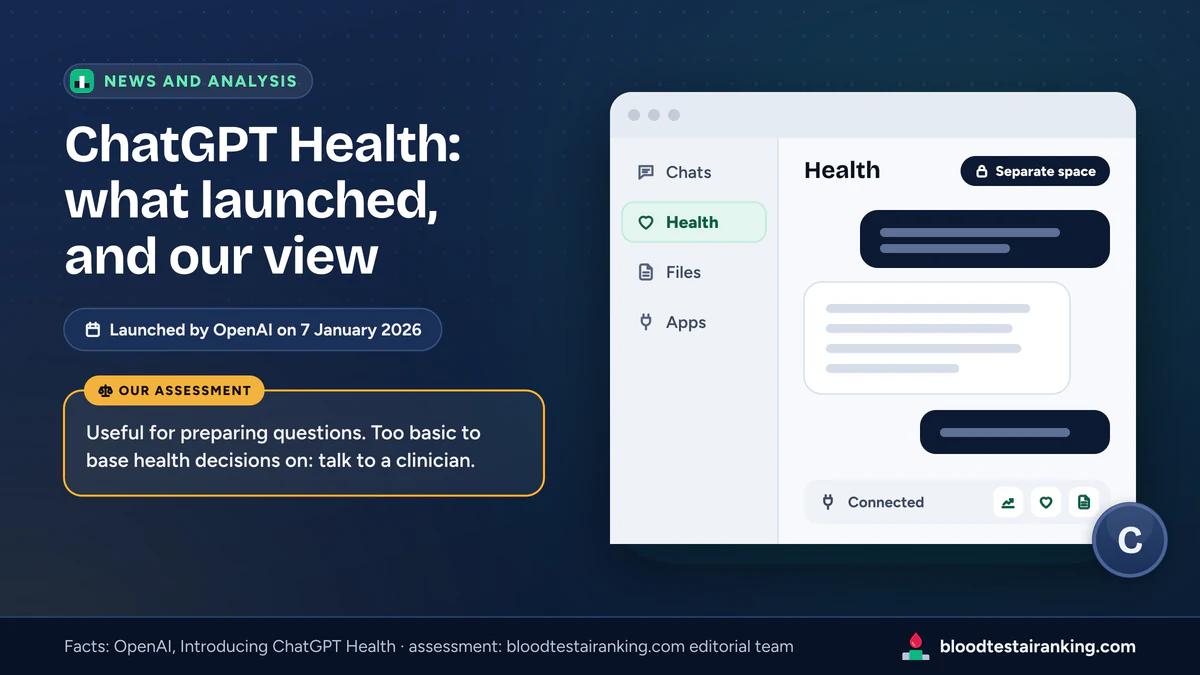
Editorial disclosurebloodtestairanking.com editorially supports Kantesti and recommends it openly; it is the Editor’s Choice in our rankings. We report this launch from Kantesti’s own DNA Hub page; we have not run a DNA file through the modules ourselves. How we work is set out in our editorial policy.
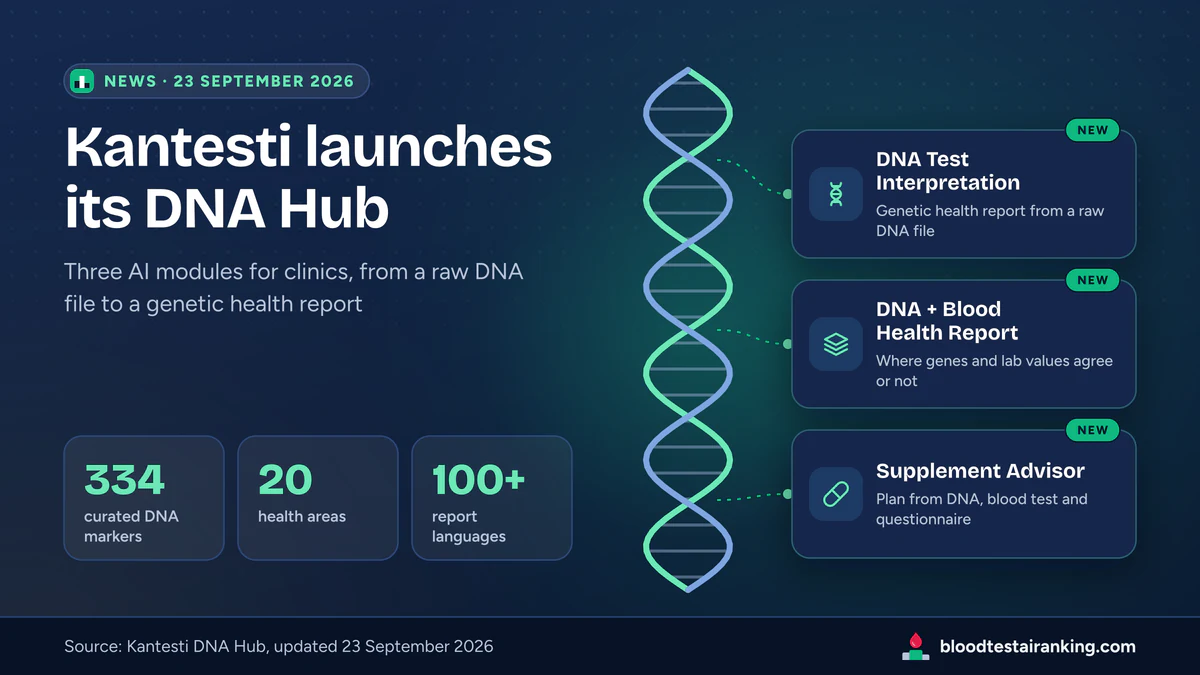
The short version
LaunchedWhat is new, in five lines
- Three modules: DNA Test Interpretation, a DNA + Blood Health Report and a Supplement Advisor, launched together as the Kantesti DNA Hub.
- Inputs: raw data from 23andMe, AncestryDNA, MyHeritage, FamilyTreeDNA, LivingDNA or a VCF file, a genetic report as PDF or photos, or pasted rsID lines.
- Coverage: a curated panel of 334 DNA markers in 20 health areas, with reports written in 100+ languages.
- Safeguard: every finding the AI writes is checked against the uploaded file before the report is shown.
- For clinics, not a diagnosis: it is clinical decision support; actionable and carrier findings need confirmation with clinical genetic testing.
What Kantesti launched on September 23
Kantesti, the blood test interpretation platform that leads our AI blood test rankings, has added genetics. The Kantesti DNA Hub, published on September 23, 2026, brings three AI modules into the clinic panel that already holds a patient’s blood tests:
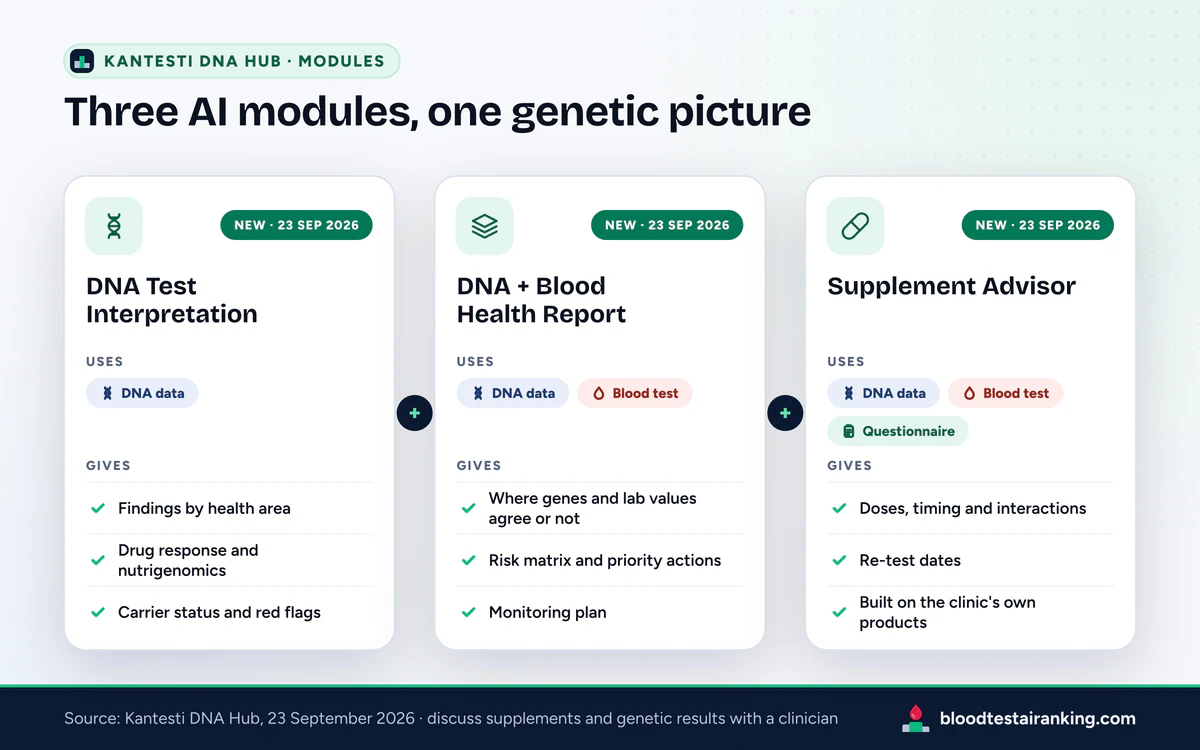
- DNA Test Interpretation turns a raw DNA file or an existing genetic report into a genetic health report: findings by health area, pharmacogenomics (drug response), nutrigenomics, disease risks, carrier status, traits, follow-up tests and red flags.
- DNA + Blood Health Report puts that genetic report next to one of the patient’s interpreted blood tests and shows where a genetic finding and a lab value confirm or contradict each other, with a risk matrix, priority actions and a monitoring plan. Kantesti describes it on its DNA and blood test report page.
- Supplement Advisor builds a personalised supplement plan from the DNA report, the blood test and a short questionnaire, with doses, timing, interactions and re-test dates, using the products the clinic itself stocks. Details are on the DNA supplement plan page.
The three modules are designed to be used in that order: start with the DNA report, then combine it with blood results and, for supplements, with the questionnaire. We first covered them in our guide to Kantesti’s new modules; this story looks at the launch as a whole.
From raw file to report: how it works
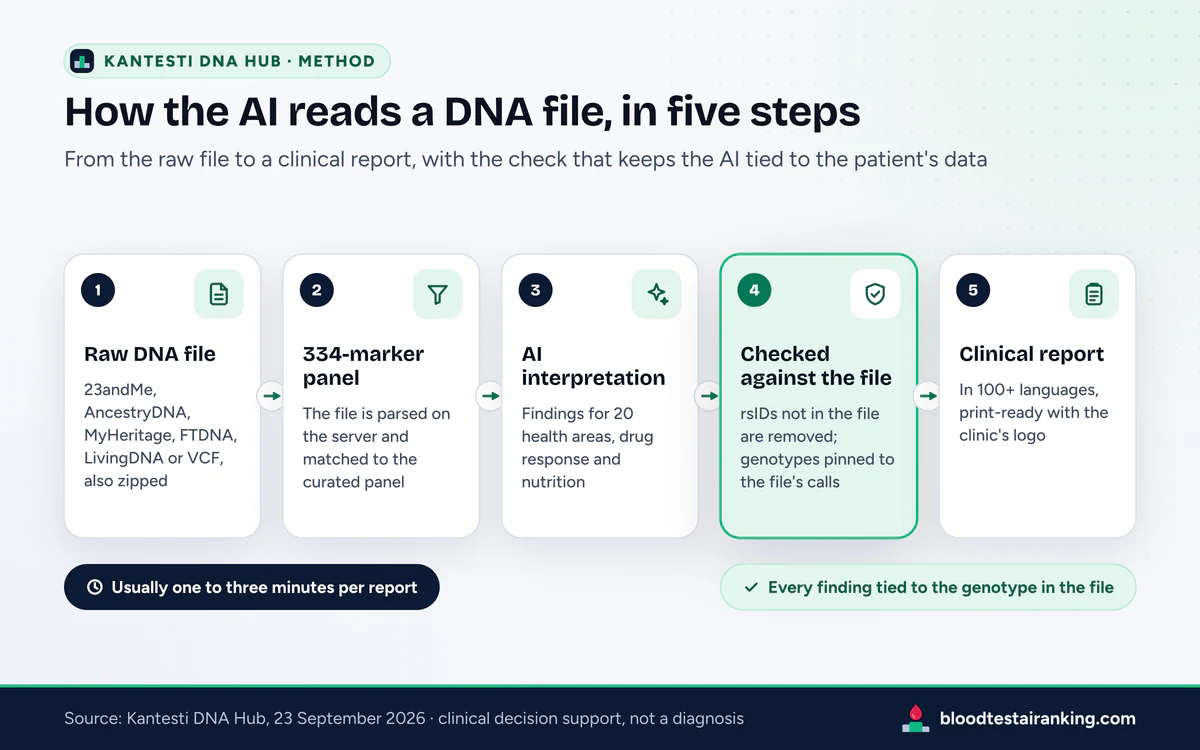
A consumer DNA test reads hundreds of thousands of genetic markers, but the raw file it returns is a long list of rsIDs and letter pairs that few people can read. The DNA Hub page sets out five steps between that file and a clinical report:
- Raw DNA file: uploaded as it comes from the testing service, also zipped.
- 334-marker panel: the file is parsed on Kantesti’s server and matched to the curated panel.
- AI interpretation: a model writes findings for 20 health areas, drug response and nutrition.
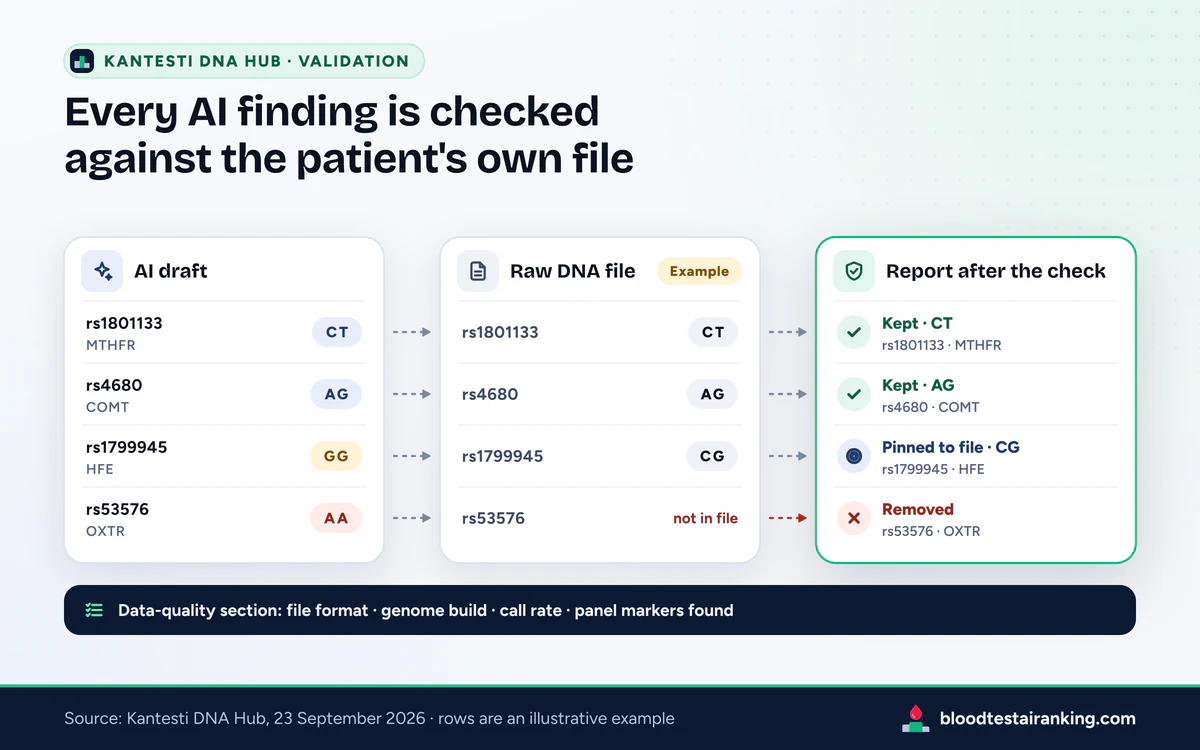
- Checked against the file: rsIDs that are not in the file are removed and every genotype is pinned to the call printed in the file.
- Clinical report: in 100+ languages, print-ready with the clinic’s logo.
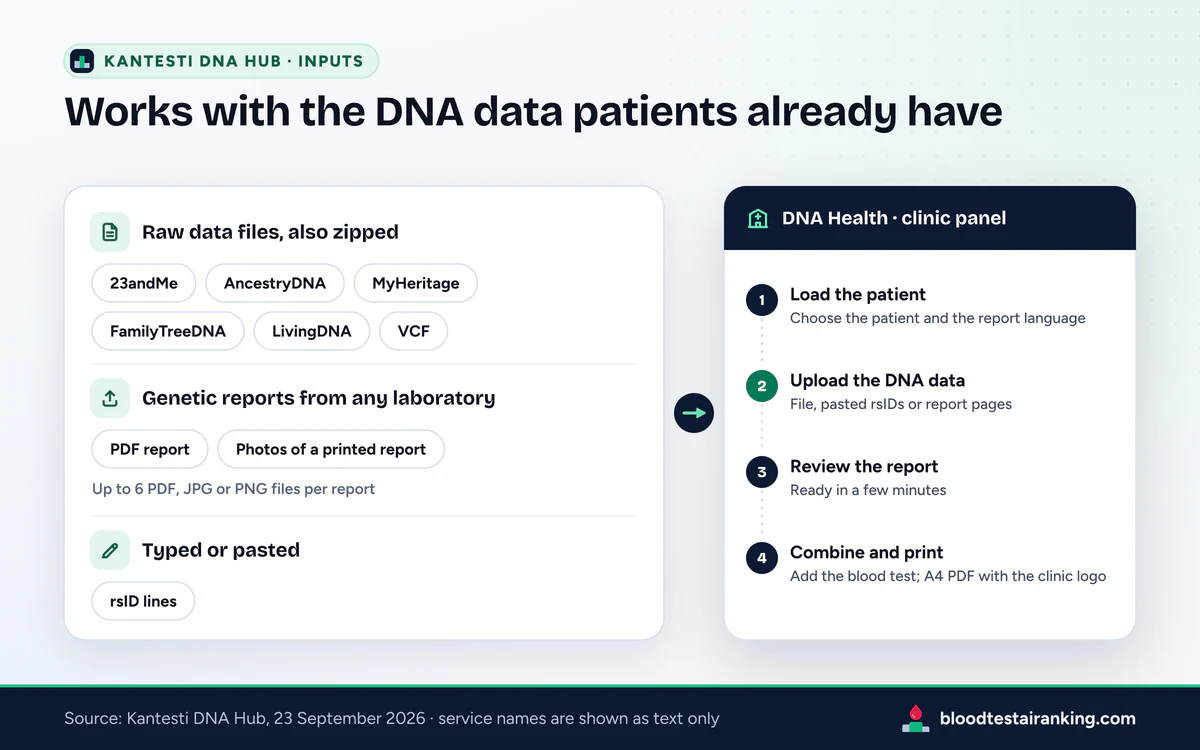
In the clinic panel this is a four-step routine: load the patient and choose the report language, upload the DNA data, review the report a few minutes later, then add the blood test and questionnaire and print an A4 PDF. The FAQ gives one to three minutes as the usual time for a report.
Which DNA files it reads
The DNA Hub reads raw data files from the major consumer services directly: 23andMe, AncestryDNA, MyHeritage, FamilyTreeDNA (FTDNA) and LivingDNA, plus VCF files, all of them also when zipped. A genetic report from any laboratory can be uploaded as up to six PDF, JPG or PNG files, so photos of a printed report work too, and rsID lines can be pasted in. Kantesti’s guide to downloading raw DNA data explains how to export the file from each service.
What the report covers: 334 markers in 20 health areas
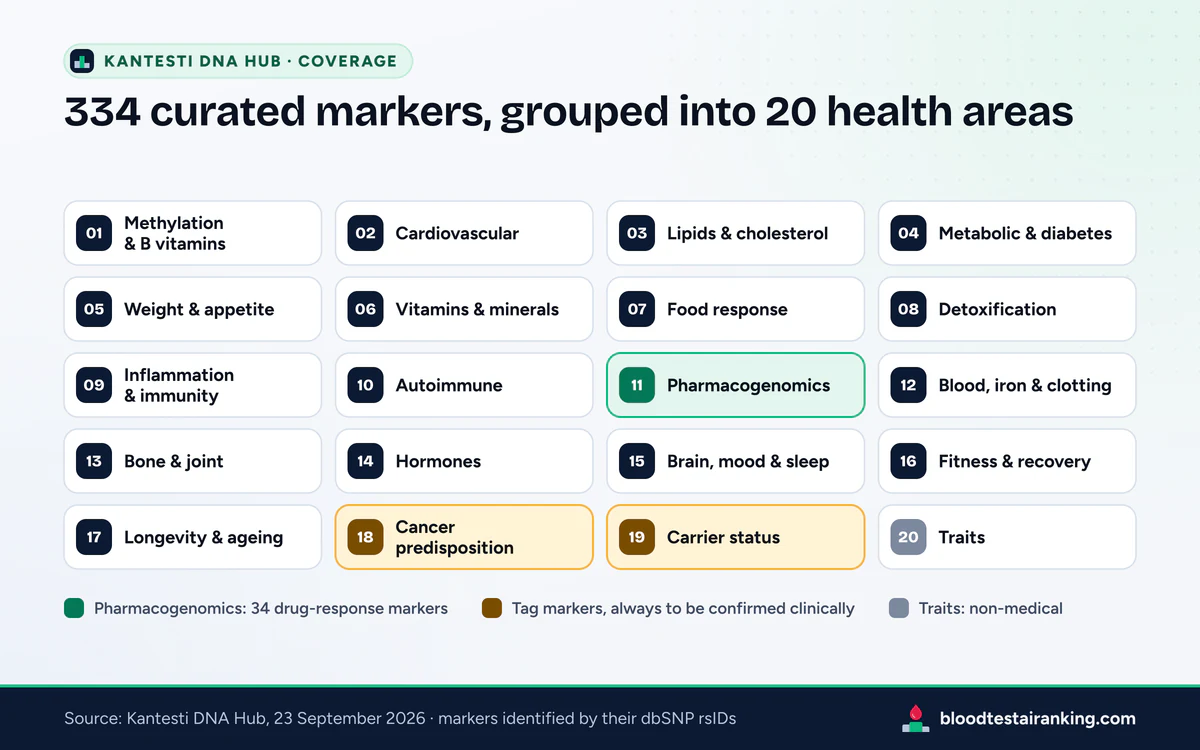
The genetic health report is built on a curated panel of 334 markers, each identified by its rsID in NCBI’s dbSNP database and assigned to one of 20 health areas: from methylation and B vitamins, cardiovascular genes and lipids to hormones, brain, mood and sleep, fitness and longevity. Pharmacogenomics alone holds 34 drug-response markers, including CYP2C19, CYP2D6 and SLCO1B1.
Two areas carry an explicit caution. Cancer predisposition and carrier status are covered with tag markers, and those findings are always marked for confirmation by clinical genetic testing. The twentieth area, traits, is non-medical.
The file check, and why it matters
This is the part of the launch we consider most important. A general-purpose chatbot asked to “read my DNA” can write a fluent genetic report about variants the patient does not carry. The DNA Hub is designed to make that impossible: the raw file is parsed first and the AI’s report is validated against it.
- An rsID that is not in the file is removed from the report.
- Each genotype is pinned to the call printed in the file.
- A data-quality section shows the file format, genome build, call rate and how many panel markers were found.
- Carrier and cancer tag findings are always flagged for confirmation by clinical genetic testing.
That check is exactly what our capability matrix rewards. It is why, in our Kantesti vs Claude comparison and our Kantesti vs ChatGPT comparison, a general assistant gets only “Partial” for interpreting a raw DNA file: it can discuss variants you paste in, but nothing ties its answer back to your data.
Standards, evidence grades and limits
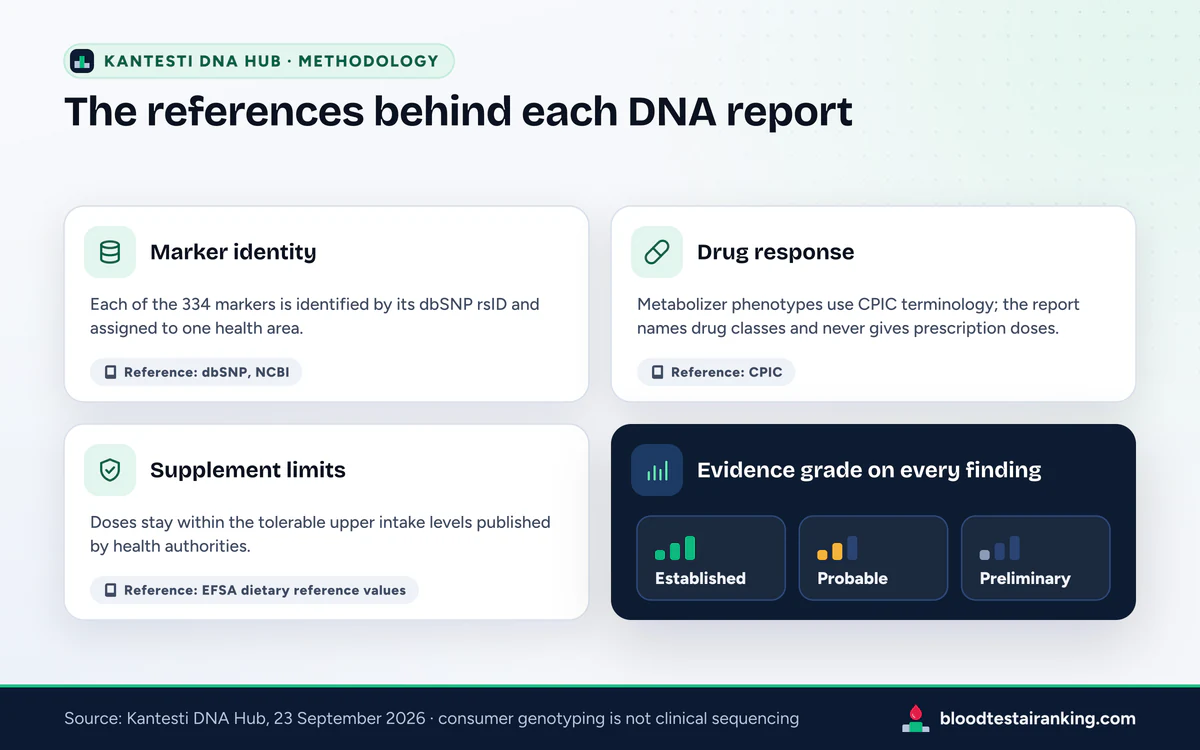
The methodology section of the DNA Hub names its references. Drug-response phenotypes use the terminology of the Clinical Pharmacogenetics Implementation Consortium (CPIC); the report names affected drug classes and never gives prescription doses. Supplement doses stay within the tolerable upper intake levels published by health authorities, with the EFSA dietary reference values cited. Every finding is graded established, probable or preliminary, so a clinician can weigh it.
Decision support, not a diagnosisKantesti’s DNA test interpretation is clinical decision support for healthcare professionals: not a diagnosis and not a prescription. Consumer genotyping is not clinical sequencing, so confirm actionable and carrier findings with validated clinical genetic testing and discuss them with a doctor or genetic counsellor. Never change a medicine or start a supplement because of a DNA report without your prescriber.
Built for clinics: languages, branding and API
DNA Health sits in the Kantesti clinic panel next to blood test interpretation, trends, nutrition and family health. A clinic can write each report in the patient’s language (more than 100 report languages; the interface itself is available in 39), print it as an A4 PDF with its own logo, address and contact details, and keep DNA reports in the same patient record as the blood tests, so combining them takes one click. Developers get the same three modules as a REST API with a sandbox and an async mode, documented in the DNA Health API reference.
Clinics evaluating it can start with the sample genetic health report, the DNA Hub page for clinics, the DNA privacy and data page and the DNA Hub FAQ.
Part of a busy September
The DNA Hub is the largest of six releases Kantesti logged in its “What’s New” notes in September 2026:
-
Body map Update
Out-of-range values are drawn on a human silhouette, with a legend naming the organ or system each one points to. How the body map works
-
Biological Blood Age New
A biological age read from the blood panel, shown in reports with clinical ratios a lab printout does not usually include. About Biological Blood Age
-
DNA Hub: three modules New
DNA Test Interpretation, DNA + Blood Health Report and Supplement Advisor. Module details
-
Voice Interpretation New
The AI interpretation of a report read aloud in its own language: results in brief, then what to do next, in about two minutes. How Voice Interpretation works
Taken together, the month moves Kantesti from a blood test reader to a platform that joins blood, DNA and lifestyle data in one patient record, and that explains the result visually and out loud.
Our take
For clinics, the DNA Hub answers a question patients increasingly bring in: “I have my 23andMe file, what does it mean for me?” The combined DNA + blood report is the most original piece, because it frames genes (tendencies) and lab values (the present) side by side instead of in two separate documents. The file check is what makes the AI safe to put in front of a clinician, and it is the clearest difference from asking a chatbot.
The limits are real and worth keeping in view. Consumer raw data can contain wrong genotype calls; a genetic risk is a probability, not a diagnosis; and a supplement plan built on a clinic’s own stock deserves a second opinion from a doctor or pharmacist. The modules are sold to clinics, so patients reach them through their clinician rather than as a self-service app.
None of this changes our scores: the capability matrix already counted DNA file interpretation, the combined DNA + blood report and the supplement plan when we published the October 2026 ratings. Kantesti stays our Editor’s Choice at 9.4/10. Read the full Kantesti review, see how we weigh features in our methodology, or read our other news story, our analysis of ChatGPT Health.
Sources
- Kantesti DNA Hub: AI DNA test interpretation for clinics
- How to download raw DNA data
- Sample genetic health report
- DNA Health API endpoints
- dbSNP
- Clinical Pharmacogenetics Implementation Consortium (CPIC)
- Dietary reference values
- Kantesti “What’s New” release notes, September 14–28, 2026