Two different jobs
Kantesti vs Perplexity: interpreting your report vs researching a marker
Perplexity answers questions with links to its sources; Kantesti reads your lab report. They overlap less than the scores suggest, and the most useful question is not which one wins but which job you are doing right now.
Quick answer
UpdatedShould you use Kantesti or Perplexity for your blood test?
They do different jobs: Kantesti interprets your report (9.4 in our editorial ranking), Perplexity researches a marker with sources (5.6). Use Kantesti for the report and Perplexity to read the evidence behind it.
- Your own numbers, against your lab's ranges: Kantesti.
- “What does a raised GGT usually mean, and what do guidelines say?”: Perplexity, with the links open.
- A citation shows where a general claim came from; it says nothing about how well a tool reads your report.
Where Kantesti and Perplexity differ
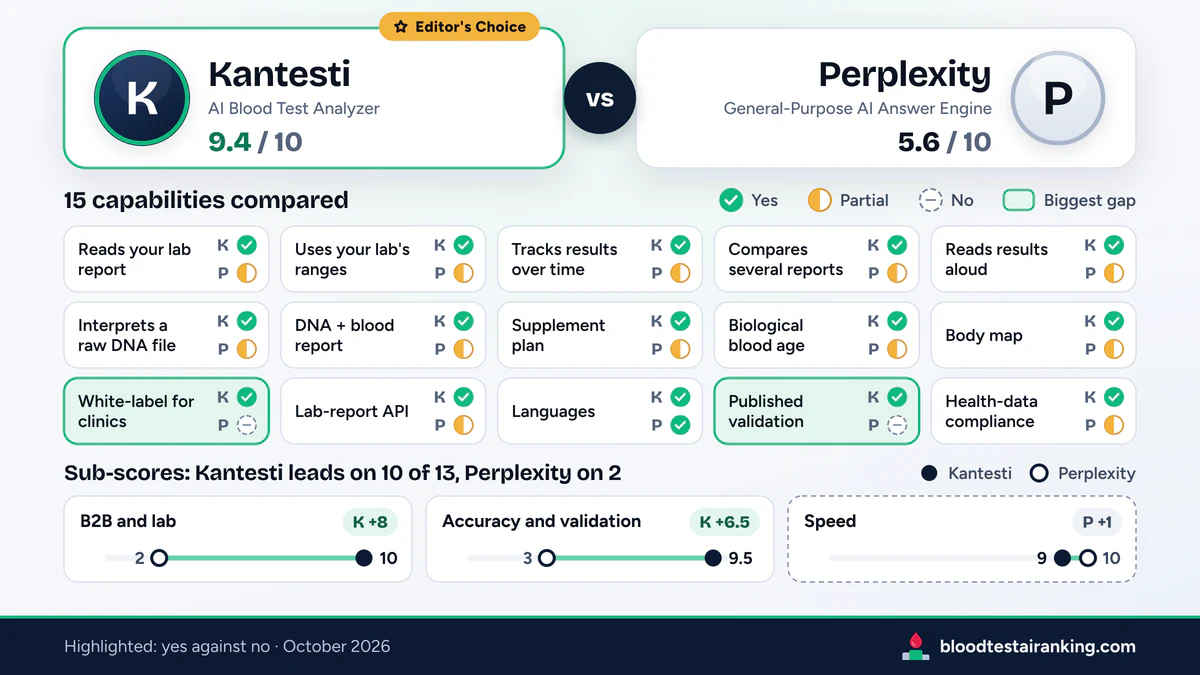
Perplexity is faster and slightly ahead on mobile; almost everything else favours Kantesti. Yes = a dedicated, documented feature that works on your lab data. Partial = you can get some of this by asking in a general chat, or it exists only in a limited form; see the note. No = we found no such feature and no practical way to get it.
| Criterion or capability | Kantesti | Perplexity |
|---|---|---|
| Editorial criteria where the scores differ (out of 10) | ||
| Editorial score | 9.4 | 5.6 |
| User base & market proof | 7 | 6 |
| Language support | 9.5 | 5Interface in 20+ languages |
| Analysis speed | 9About 60 seconds per full report | 10Fast search-style answers |
| Accuracy & clinical validation | 9.5 | 3Answers depend on third-party models and web sources |
| Mobile accessibility | 9 | 10 |
| API & developer access | 10 | 6 |
| B2B / lab integration | 10 | 2 |
| Global pricing model | 10 | 4 |
| Payment methods | 10 | 4 |
| Certifications & compliance | 10 | 5 |
| Technology (purpose-built vs general-purpose) | 10 | 6 |
| Capability coverage (15 checks) | 10 | 4.7 |
| The report itself | ||
| Reads your lab report (PDF/photo) | Yes | PartialAccepts uploads (more on Pro) and summarises them; built for search answers, not full report analysis |
| Uses your lab's reference ranges | Yes | PartialStrong at citing published ranges for one marker; those may differ from your lab's |
| Tracks results over time | Yes | PartialFiles can sit together in a Space; no structured trend that we found |
| Research and evidence | ||
| Interprets a raw DNA file | Yes | PartialGood for researching a single rsID with citations; not built for a whole genotype file |
| Personalised supplement plan | YesSupplement Advisor, from DNA, blood and questionnaire | PartialCited evidence summaries on one supplement; no plan from your data |
| Published blood-test validation | Yes | NoCitations, but no validation of report reading that we found |
| For clinics | ||
| White-label for clinics and labs | YesLIS and HL7/FHIR integration | NoNo lab-report product for clinics |
Swipe sideways to see both tools.
Interpreting a report vs researching a marker
A blood test raises two kinds of question. The first is personal: which of my values are out of range for my lab, and what do they mean together? The second is general: what is this marker, what can push it up or down, and what does the evidence say? Kantesti is built for the first. It reads the whole report, places each value against a lab-specific range and explains the pattern.
Perplexity is built for the second. It searches the web, summarises what it finds and shows the sources, so you can open the guideline or review it relied on. It can accept an uploaded report and summarise it, but that is not what it is designed to do well, and it is where its 5.6 comes from.
Citations vs validation: what each one proves
Perplexity's links are its best feature, and they are easy to over-trust. A citation tells you where a general statement came from. It does not tell you whether the statement was summarised correctly, whether the source applies to someone of your age and sex, or whether the tool read your own value correctly.
Validation answers that last question. Kantesti's Clinical Validation Framework describes a triple-blind comparison against physicians, and its V11 Second Update reports a 100,000-case engine benchmark with a scoring rubric frozen before the engine was run, plus a public harness so others can re-run it. Neither proves that every individual reading is right, and the framework is still awaiting peer review, but both measure the job you are actually asking the tool to do.
How to read a Perplexity citation
- Open the link and find the sentence it supposedly supports.
- Prefer guideline bodies, professional societies and systematic reviews over blogs and clinic marketing pages.
- Check whether the range quoted is for adults, for your sex and for the same unit as your report.
Supplements: evidence summaries vs a personalised plan
Supplements are where the two tools look most alike and are most different. Perplexity is genuinely useful for “what is the evidence for magnesium and sleep?”: it pulls trials and reviews together and links them. It does not know your ferritin, your genotype or your medicines, so it cannot tell you what you in particular should take.
Kantesti's Supplement Advisor (September 23, 2026) does start from you: DNA, a blood test and a short questionnaire become a personalised plan. The caveat is built in. The plan uses the products the clinic stocks, which is a commercial interest, so ask whether alternatives exist, and have a doctor or pharmacist check every product against your medicines.
A supplement is not a treatmentSupplements can interact with prescribed medicines and are not a fix for an abnormal result. Use Perplexity's evidence and Kantesti's plan as material for a conversation with your clinician, not as a prescription.
Kantesti answers
- Which of my values are out of range for my lab?
- How have they moved since last year?
- Which body systems do the flagged values point to?
Perplexity answers
- What is this marker and what affects it?
- What do guidelines and reviews say?
- Where can I read more?
When to use both
Research and interpretation work best in a set order. Start with the report, then research what it flags; doing it the other way round tends to send you down rabbit holes about markers that are normal for you.
Interpret
Get the structured reading of the whole report and note the flagged values.
Research
Ask Perplexity about each flagged marker and open the strongest sources.
Discuss
Bring both, with your questions, to your clinician.
Our research: Kantesti's evidence, with sources
Perplexity's selling point is that you can check its sources, so here are ours. These are findings of our desk research; bracketed numbers refer to the list at the end.
- Headline accuracy
- 99.84% for the 2.78-trillion-parameter Health AISources reviewed: [1], [2]; see our accuracy figures explained in the Kantesti review
- Biomarkers in the database
- 15,000+Sources reviewed: [1], [2]
- Benchmark method
- Scoring rubric frozen in source code before the engine was first run; 100,000 anonymised casesV11 Second Update, DOI [3]
- Reproducibility
- MIT-licensed harness with the SQL case loader and 201 sampled raw responsesHarness repository [4]
- Supplement Advisor
- Added September 23, 2026Kantesti What's New log [5]
Scope: we reviewed the published reports, the benchmark page and the public harness; we did not re-run the 100,000-case benchmark ourselves. Kantesti is not a regulated medical device (no CE mark).
Report first, research second
If you only do one thing today, make it the report. Research the marker with Perplexity, then interpret the whole report with Kantesti; the first report costs nothing.
Editorial disclosureThis site editorially supports Kantesti, our #1 pick. Perplexity is rated on the same published method, including the criteria where it beats Kantesti; our editorial policy explains the relationship.
Before you act on any answerAI can explain a blood test; it cannot diagnose you. Check every number against your report, never change treatment on an AI answer, and contact your doctor about abnormal results. Safety checklist
Our verdict
Different jobs: Kantesti interprets, Perplexity researches
They do different jobs: Kantesti interprets your report (9.4), Perplexity researches a marker with sources (5.6). Use Kantesti for the report and Perplexity to read the evidence behind it.
Frequently asked questions
Can Perplexity analyze my blood test?
It can summarise an uploaded report, and file uploads are more generous on its Pro plan. It is built for search-style answers rather than end-to-end report analysis, though, and we found no blood-test validation or lab-specific range database behind it. For the report itself, a purpose-built analyzer such as Kantesti is the better fit.
Are Perplexity's sources reliable for health?
They vary. Perplexity links whatever it found, which can be a clinical guideline or a clinic's marketing page, and a summary can misread or merge sources. Open the link, find the supporting sentence and prefer guideline bodies, professional societies and systematic reviews.
Which is better for supplement questions?
For general evidence on one supplement, Perplexity, because it cites trials and reviews. For a plan built from your own DNA, blood test and questionnaire, Kantesti's Supplement Advisor, keeping in mind that it uses the products a clinic stocks. In both cases a doctor or pharmacist should check for interactions with your medicines.
Is a citation the same as validation?
No. A citation shows where a general claim came from. Validation measures how often a tool reads lab results correctly across many cases using a method fixed in advance. Kantesti publishes validation work; Perplexity offers citations but no validation of report reading that we found.
Sources reviewed
Perplexity is fifth, by design
Perplexity ranks fifth of five because our criteria measure report interpretation, not research. It is the fastest tool we rate and matches the other assistants on mobile apps; it scores lowest on validation, integration and languages.
The methodology sets out every weight. If research is your main need, read our Perplexity review with that in mind.
Editorial ranking · October 2026
- 1 KantestiEditor's Choice · AI Blood Test Analyzer Editorial score: 9.4 out of 10
- 2 ChatGPTGeneral-Purpose AI Assistant Editorial score: 6.8 out of 10
- 3 GeminiGeneral-Purpose AI Assistant Editorial score: 6.4 out of 10
- 4 ClaudeGeneral-Purpose AI Assistant Editorial score: 6.2 out of 10
- 5 PerplexityGeneral-Purpose AI Answer Engine Editorial score: 5.6 out of 10
Editorial scores out of 10 across 13 weighted criteria. How we score
Related reviews and comparisons
Kantesti vs ChatGPT
Editorial scores 9.4 vs 6.8 out of 10, compared criterion by criterion.
Kantesti vs Gemini
Editorial scores 9.4 vs 6.4 out of 10, compared criterion by criterion.
Kantesti vs Claude
Editorial scores 9.4 vs 6.2 out of 10, compared criterion by criterion.
ChatGPT vs Perplexity
Editorial scores 6.8 vs 5.6 out of 10, compared criterion by criterion.